Science review Online / academic literature (Austria-associated 1982 authors; UCF-associated 2007 authors); Transylvania as literary geography only
Vampire Math: 1982 Transylvania Models, 2007 Extinction Arithmetic, and Why Film Vampires Fail the Spreadsheet (2026)
Dated tour of academic vampire models — Hartl & Mehlmann 1982 renewable-blood math, Efthimiou & Gandhi 2007 extinction argument. Entertainment, not occult how-to.
Sign in to save stories to your shelf.
First the physicists cosplayed zombie outbreaks. Then the vampires got spreadsheets.
On February 24, 2016, this desk treated a “recent spate” of undead academic papers as a vibe shift: after zombie models, vampire population math was having a moment in the popular imagination.
That page is a historical predecessor. This 2026 rewrite keeps the grin and does what SEO-era science blogs skip: put years on every paper, admit most of this is serious math wearing a cape, and refuse any reading that sounds like “how to become.”
No how-to-become-vampire content. Not even as a joke recipe.
The 1982 classic: renewable humans as a resource problem
Long before Twilight fan calculus, Austrian mathematicians Richard Hartl and Alexander Mehlmann published “The Transylvanian Problem of Renewable Resources” (1982, RAIRO — Operations Research).
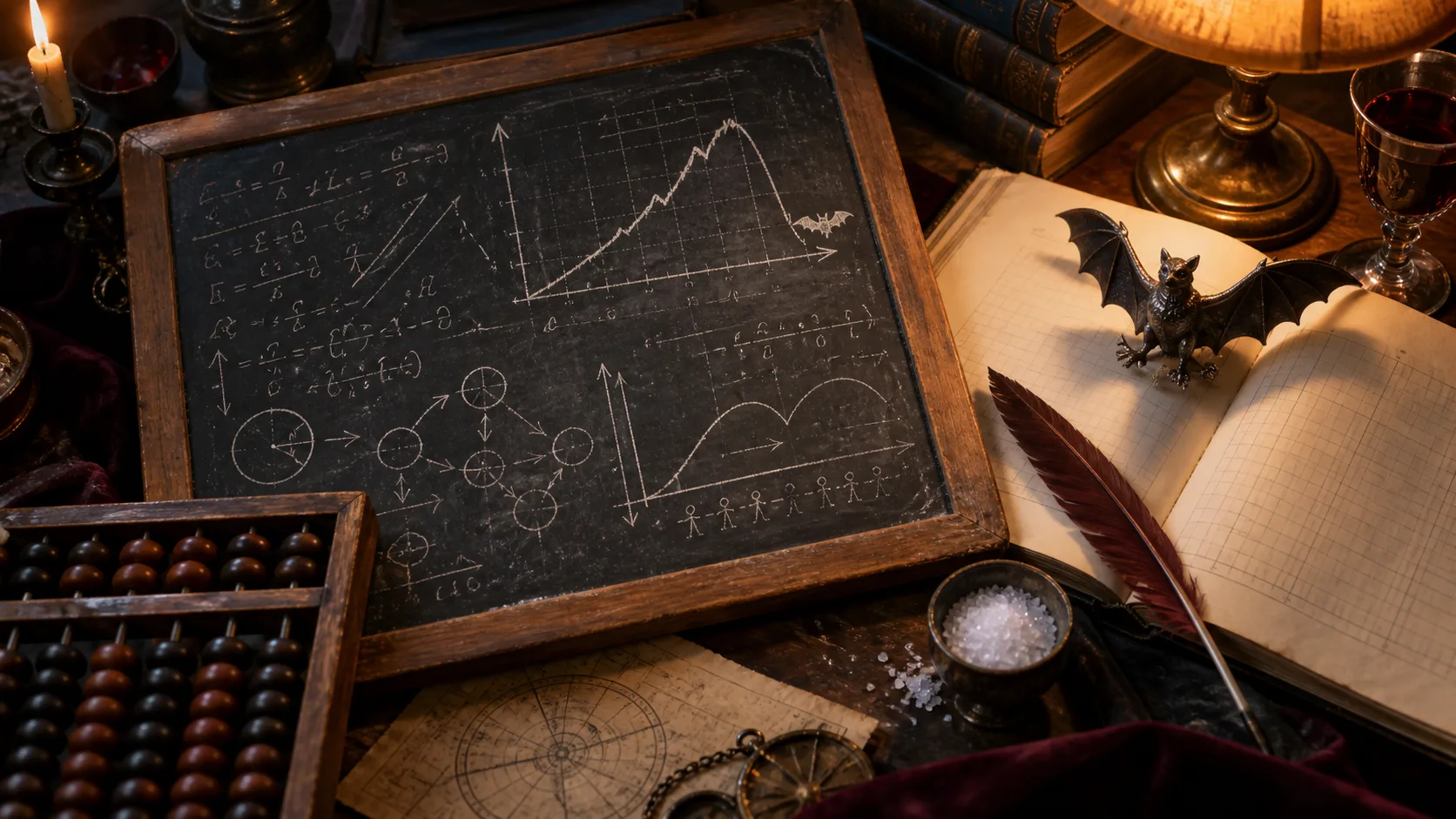
According to the paper’s framing, vampires become optimal-control agents feeding on a renewable human resource. Categories in the telling our 2016 piece echoed:
- the asymptotically satiated vampire
- the blood-maximising vampire
- the unsatiable vampire
Core tension: every human you turn is a worker removed from the blood farm. Prey–predator sustainability is the puzzle. Discount rates and strategies decide whether humans persist or get liquidated into an empty larder.
That is 1982 operations-research play, not ethnographic fieldwork in the Carpathians.
The 2007 gut punch: cinema feeding rates vs. human survival
A second cluster — popularized in mid-2000s coverage of Costas J. Efthimiou and Sohang Gandhi’s “Cinema Fiction vs Physics Reality” discussion (physics/0608059 lineage; Live Science wrote it up as vampires being a “mathematical impossibility” under movie rules) — runs geometric growth arguments.
If vampires feed and convert on Hollywood schedules, humanity should already be a rumor. Even a gentler once-a-month conversion fantasy, in the simplified arithmetic, collapses the human population on a short multi-year fuse.
Assumption baked in: the writers got vampire appetite and conversion mechanics “right.” Change the diet to covert sips without industrial turning — the Anne Rice / quiet barroom predator model — and the spreadsheet stops screaming extinction. Our 2016 piece already winked at that loophole: maybe the undead beside you are portion-controlled.
Wink acknowledged. Still fiction.
What “researchers say” meant in 2016 — and means in 2026
It meant academics published playful models using vampire metaphors to teach dynamical systems, resource economics, and Fermi-problem skepticism about pop monsters. It did not mean a lab confirmed nosferatu.
Later status check (2026): these remain cited curiosities / pedagogical chestnuts, not an expanding empirical vampireology program. Zombie-model fashion (Cornell 2015, etc.) and vampire-model fashion share a genre: serious tools, silly skin.
Never present the 2016 MA article as breaking discovery. It was already summarizing decades-old and years-old papers.
Conspiracy-curious corner (salted)
Yes, the extinction argument assumes noisy, high-conversion vampires. A hidden, low-feed population could dodge the math — which is exactly why unfalsifiable cryptids love the “they’re smart and discreet” patch. Math constrains movie vampires harder than novel vampires. That is a literary observation wearing a calculator.
How to read undead “studies” without joining a cult
- Demand the citation year.
- Ask whether the paper is metaphor or claim of existence.
- Separate conversion-heavy cinema rules from covert feeder fiction.
- Pair with entertainment lists; do not build a lifestyle out of a differential equation.
- If a headline says “scientists prove vampires,” reach for the salt first and the PDF second.
What we refused to do
We will not give rituals, induction steps, or “become undead” guidance. We will not invent new peer-reviewed vampire detections. We will not treat 1982 or 2007 work as 2026 breaking news.
Salt freely. If vampires run the night economy this efficiently, the 2007 paper implies we should already be livestock — and yet here you are, reading SEO. Cheerful inconsistency is the genre’s oldest plot armor.
From Stoker to spreadsheet: the assumption stack
Almost every vampire paper smuggles assumptions from fiction: conversion efficiency, feeding interval, visibility, whether the undead compete or cooperate, whether sunlight rules are hard constraints, whether blood is the only trophic pathway. Hartl & Mehlmann (1982) make the resource-management tension explicit. Efthimiou & Gandhi (2007) stress-test cinematic maximalism. Neither dataset includes a captured specimen. They include rules borrowed from stories.
That is fine — applied math does this with zombies, dragons, and zombies-again — as long as the headline does not launder the metaphor into ontology.
Why our 2016 framing felt “current”
Because zombie models were having a pop-science moment (2014–2016 media cluster), and editors love a sequel. “Vampires are next” is a narrative convenience, not a survey of funding priorities. In 2026, the honest sequel is: the papers are still clever, still dated, still not a census of the night.
Dated map of the “vampire world” papers
- 1982 — Hartl & Mehlmann: optimal blood strategies; renewable human resource; satiation classes.
- 2007 — Efthimiou & Gandhi (+ Live Science amplification): cinematic feeding/conversion rates vs. continued human existence.
- 2014–2016 — Pop-science undead cluster (zombies especially) makes editors reach for vampire sequels; our 2016-02-24 predecessor rides that wave.
- 2026 — Same equations, clearer labels: metaphorical math, not occult epidemiology.
No, this is not stealth pathogen content
Undead population models sometimes sit next to real epidemic metaphors in the same media diet. This article stays on fictional vampires and published tongue-in-cheek papers. No synthesis, enhancement, or weaponization guidance — not for imagined viruses, not for anything else. If you came for lab advice, you are in the wrong castle.
Sources
- Claim element: Historical predecessor (Feb 24, 2016) — Attribution: Monstrum Athenaeum original — Link: Arithmetic Key to Unraveling Vampire World…
- Claim element: 1982 operations-research vampire model — Attribution: Hartl & Mehlmann, RAIRO — Link: The Transylvanian problem of renewable resources
- Claim element: 1982 PDF mirror — Attribution: NUMDAM / RAIRO archive mirrors — Link: ro1982160403791 PDF
- Claim element: 2007 cinema-vs-physics vampire arithmetic — Attribution: Efthimiou & Gandhi (arXiv html) — Link: Cinema Fiction vs Physics Reality
- Claim element: Popular 2007 coverage — Attribution: Live Science — Link: Vampires a Mathematical Impossibility…
About this article
Entertainment and historical academic-humor commentary only — not proof that vampires exist or do not exist, not occult instruction, and not guidance on blood-related practices, identity transformation, or harm. “How to become a vampire/werewolf” content is intentionally absent. Mathematical models are metaphors and Fermi exercises. This 2026 article is a brand-new legacy refresh; the 2016 URL is a historical predecessor, not a prior publication of this text. MonstrumAthenaeum.org is for mature audiences who can tell a differential equation from a doctrine.
Original publication credit
Original title: Arithmetic Key to Unraveling Vampire World Says Researchers. The preserved copy has no named writer credit. Originally published February 24, 2016.