Historical report Online / U.S. coastal true-crime folklore peg (2015 Athenaeum beach-discovery reference; no private address)

Hunters Become the Hunted: Archiving a 2015 Monster-Hunter Thought Experiment

Archival feature on Athenaeum’s Sept 22, 2015 “hunters become the hunted” essay—unsolved-murder dread, beach discovery peg, monster-hunter speculation. No live case claims.

By Cryptid deskFirst published Updated 5 min read
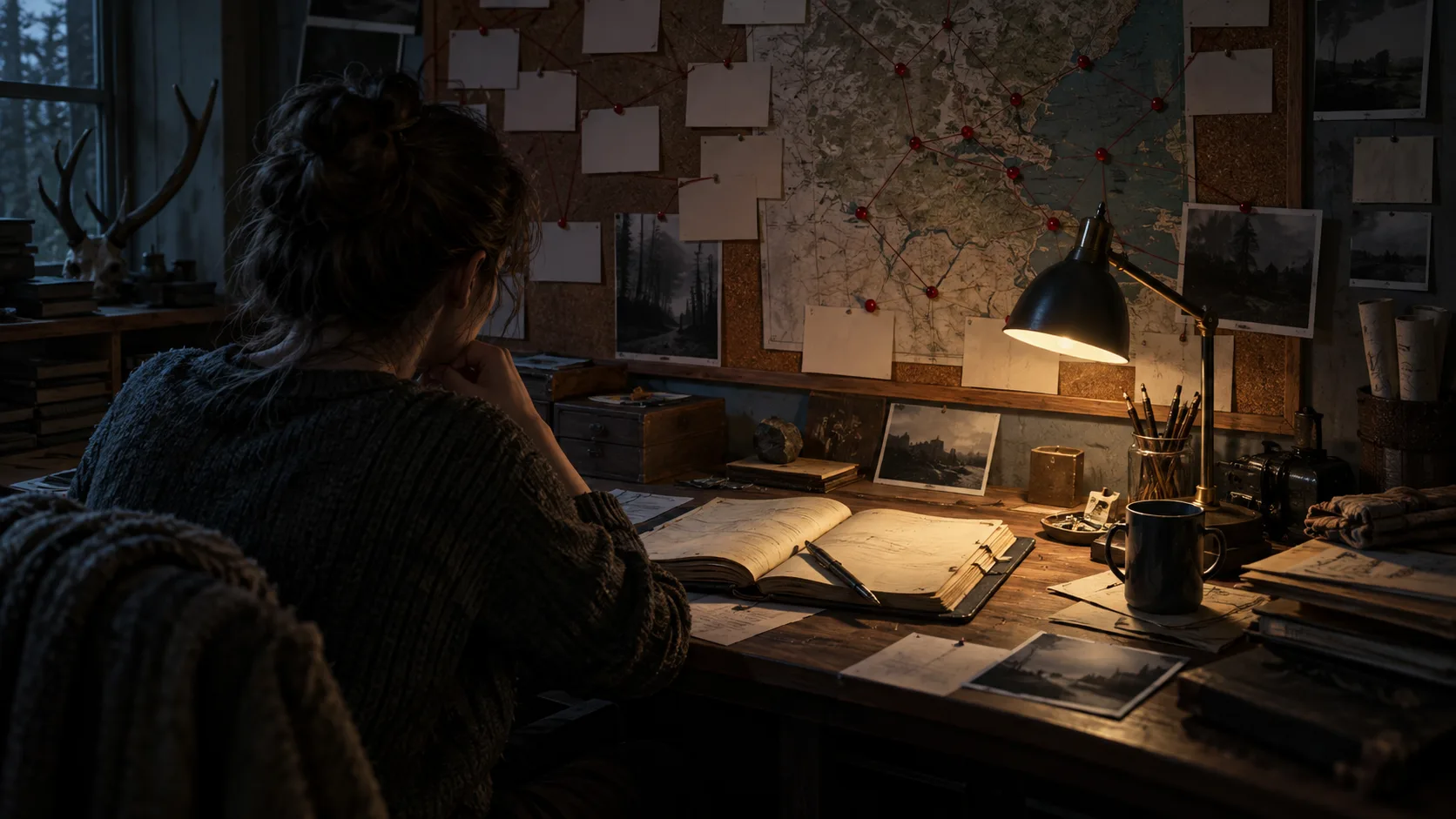
A dim study 'thought-experiment' tableau: a corkboard wall of blank case-file cards and a regional map stuck with red pins, a single desk lamp, an open dog-eared notebook, and a silver-tipped implement resting as a prop across the pages — the room of someone theorizing that monster-hunters leave the nameless dead.

Sign in to save stories to your shelf.

Original Athenaeum reporting date: September 22, 2015.

On September 22, 2015, Monstrum Athenaeum filed a short, conspiracy-curious provocation: what if some of the country’s nameless dead were not only victims of human predators — but the leftovers of someone (or something) hunting monsters?

That is a late-night thought experiment, not a blotter update. This 2026 package archives the bit. It does not claim any specific homicide is “solved” by cryptids. It does not assert that any mid-2010s beach discovery remains open, closed, or reclassified today without verification. It keeps the original reporting date loud and the speculation labeled.

The 2015 hook: flipping the hunter script

The original piece opened with parental caution theater — creepers, stalkers, the ordinary human hazards of sidewalks and parking lots — then swerved into paranormal habit: believers who already suspect vampires, werewolves, and darker taxonomy behind mutilations and disappearances.

Then came the pivot that earned the headline.

What if perception is skewed? What if a fraction of unidentified killers leaving John and Jane Does are not “the bad guys” in the folklore sense — but monster hunters cleaning up something that does not belong in a morgue drawer?

Says the 2015 Athenaeum voice: crazy-sounding on purpose. Entertaining on purpose. Not a tip line.

The article gestured at a then-recent discovery of a dismembered body found in a tarp/duffel-bag context near concrete barriers on a beach, with identity and perpetrator unknown as of that September 2015 filing. We will not invent which coastal case that sentence meant, invent a victim name Athenaeum did not print, or declare 2026 investigative status. Mid-2010s U.S. beach torso discoveries existed in public news (including earlier Cape Cod “Town Neck” coverage that matches the duffel/tarp/beach shape in other outlets). The Athenaeum’s 2015 graf treated “recent” as newsroom weather, not a case file for us to reopen.

Archive discipline: dated claim → dated framing. No “still at large” present tense without a verified, sourced update — and this desk is not running a missing-persons unit.

Unsolved-murder statistics as mood lighting

The 2015 piece cited a grim national vibe: since 1980, “over 200,000” unsolved murders in the United States, as the article put it. Treat that as the original’s rhetorical weather — a scale-of-dread number used to make room for supernatural hypothesizing — not as a freshly audited DOJ spreadsheet for 2026.

Big numbers make folklore feel plausible. That is how human brains work. It is also how entertainment desks accidentally sound like they are investigating. We will not.

Monster-hunter logic (entertainment only)

If you grant the premise that predators-not-human sometimes feed on people — a premise Athenaeum explores as lore, not as courtroom fact — then the next folklore move is inevitable: someone hunts back.

Dismemberment, concealment, beach dumps: horror fiction has always used those beats for vampire insurance policies and werewolf cleanup crews. Urban fantasy paperbacks and late-night message boards love the idea of a secret guild doing ugly work so civilians can sleep. The 2015 article asked readers to hold that fiction-shaped lens over a real, ugly news fragment.

Hold it. Then put it down.

Real victims are not props. Real families do not need a cryptid desk cosplaying detectives. The correct 2026 posture is archival: here is what Athenaeum said on September 22, 2015; here is how sensational the nation felt about anonymous violence; here is the monster-hunter flip as cultural fanfic hanging off a news peg.

Why the flip still seduces search traffic

Because it flatters the reader. It turns helplessness into a secret war. It suggests the night has rules, just occult ones. Conspiracy-curious media lives on that seduction. A decade later, the responsible move is to show the seduction working — and to mark it as seduction.

Also because true-crime podcasts trained a generation to treat every tarp as a season arc. Athenaeum’s 2015 piece arrived before that boom fully matured, but it already spoke the language: unnamed body, unknown killer, invite to theorize. Theorizing is fine. Mistaking theory for investigation is how archives become hazards.

What this refresh will not do

  • Will not name an unverified beach case as “the” Athenaeum referent.
  • Will not claim any homicide is the work of a monster hunter.
  • Will not state that a killer “is still at large” as of 2026.
  • Will not offer disposal, concealment, or “how hunters work” procedures — entertainment theory only, and thin at that.
  • Will not publish private addresses or invite crime-scene tourism.

Grain of salt, sharpened

According to the original’s own logic, the beach discovery could be mundane human horror. It could be something weirder. “Could” is doing all the work. “Could” is not evidence.

A decade later, the useful artifact is not a tip. It is a timestamped example of how quickly this site — and the wider weird-news ecosystem — can braid true-crime dread with cryptid wish-casting.

A note on anonymity and ethics

The 2015 Athenaeum piece thrived on namelessness: unknown victim, unknown killer, open-ended supernatural maybe. Namelessness is also how speculation becomes cruelty. Someone’s person became a tarp in a headline. Someone’s family may still be living inside that silence.

So the archival move is double-bound. We preserve the thought experiment because it is part of the site’s legacy inventory. We also refuse to use anonymity as a license to invent a cryptid conviction. If a reader wants true-crime updates, they can go to newsrooms that actually work cases. Athenaeum’s job here is to timestamp a mood: September 2015, America half-convinced the dark had secret janitors.

Grain of salt: No Athenaeum confirmation that monster hunters walk U.S. beaches. No present-tense case status claims. The hunters-become-hunted script stays in the archive where it belongs — labeled, dated, and salted.


Sources

  • Claim element: Historical predecessor (2015-09-22) — Attribution: Monstrum Athenaeum original — Link: Hunters become the hunted
  • Claim element: Public example of mid-2010s beach torso news shape (not asserted as Athenaeum’s unnamed referent) — Attribution: WCVB / Boston Globe Town Neck coverage (2014+) — Link: WCVB · Globe

About this article

Entertainment / historical folklore commentary only — not true-crime investigation, not a tip line, not a claim that any homicide was committed by or against cryptids. Real violence referenced in period news involved real victims; treat them with decency. This 2026 article is a brand-new legacy refresh; the 2015 URL is a historical predecessor, not a prior publication of this text. MonstrumAthenaeum.org is for mature audiences who can tell a thought experiment from a case file.

Original publication credit

Original title: Flipping the Script: The Hunters Become The Hunted. The preserved copy has no named writer credit. Originally published September 22, 2015.
Continue reading.

Stay with the strange.

Explore the front page →