Folklore L’Argentenay, eastern Ile d’Orleans, Quebec, Canada — literary setting
Jean Plante’s Loup-Garou: The Werewolf at a Quebec Mill
A cruel miller, a refused beggar and a reddish dog at the door: Wenceslas-Eugène Dick’s Quebec loup-garou tale saves its revelation for the end.
Sign in to save stories to your shelf.
This one comes from the page, not the field. It is a literary folk tale — not a sighting logged in any year — and its best source is a 1918 collection, Légendes et revenants, where Wenceslas-Eugène Dick set down the story of Jean Plante and the loup-garou. A narrator, Antoine Bouet, tells it as something that happened some twenty years before his telling, which is how these stories always arrive: secondhand, worn smooth, still cold at the center.
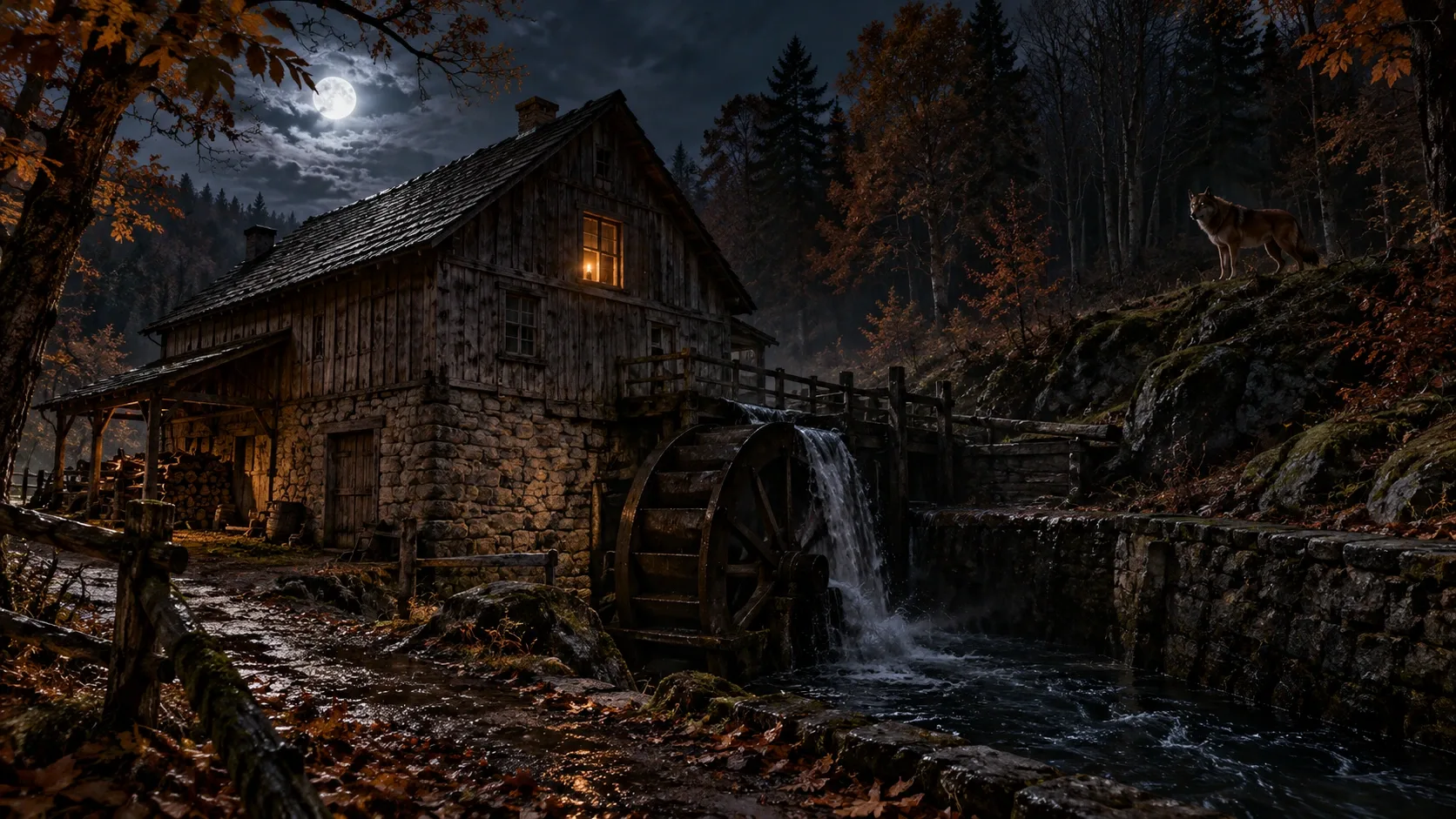
Jean Plante kept an old mill near l'Argentenay. He drank hard and his temper ran hot, and he slept alone on the upper floor while his younger brother Thomas worked the place by day. One afternoon a beggar came asking charity. Jean answered with his boot. The beggar said nothing — only fixed him with a look that a wiser man would have read as warning — then went on down the hill, where Thomas too turned him away. The old man made a gesture toward the mill and vanished into the trees.
From that moment the mill would not run. No jam, no broken gear, nothing a hand could find; it simply stopped. Thomas named it a curse. Jean laughed, beat his brother for the superstition, and Thomas left in anger with a threat on his lips.
That night the haunting began. Drunk, Jean fell down the stairs and slept in the open; a gust extinguished the candle, lights later slid through the empty mill, chains rattled in the dark. From the edge of the trees a large reddish dog watched him. Night after night it went on — Jean stalking the rooms with his scythe, the noise always fleeing to whatever room he had just left. By the week's end he was feverish and worn thin, the mill still dead.
On the eighth evening — All Saints’ Day — with wind and rain outside, he stayed and drank in defiance. At midnight the red dog came in and sat, calm, staring. He extinguished the candle while trying to trim it; the matches he expected to find were missing. Terror broke him. "C'est un loup-garou!" he cried, and swung the scythe.
The blade struck. At once the mill lurched back to life and a light bloomed in the room — and here is where the tale turns its knife. It was Thomas who stepped in holding a lit match, and Thomas was missing part of an ear. On the floor lay a bloody piece of a dog's ear. Jean understood then, and the understanding is given in three words: "C'était donc toi!" — so it was you.
Dick lets the mechanism stay in shadow. The ending ties the brother’s missing ear to the vanished dog without explaining the mechanics of the transformation. What it spells out plainly is the cost. Jean Plante did not die of it. He laughed, and the chapter closes on the one fact it is sure of: that the miller went mad.
It is a moral engine dressed as a ghost story — charity refused, a brother beaten, a scythe swung at the dark — and like the best of the loup-garou tradition it saves its cruelty for the man who thought himself above the warning.
Sources
- "Une histoire de loup-garou," Légendes et revenants (1918) — public-domain French text by Wenceslas-Eugène Dick; full chapter read for plot and ending.
- "Légendes et revenants," Laurentiana — Dec. 2 2016 blog revisiting the Dick/Caron collection.
Original illustration of the folklore described in the article.