Cultural history Nantes, France
Nantes Put a Werewolf in Its Anatomy Lesson
A 2023 Nantes museum exhibition brought werewolves into comparative anatomy, using imaginary creatures to ask surprisingly practical questions.
Sign in to save stories to your shelf.
Give a werewolf a place in a natural-history museum, and an awkward question follows: where should it go on the family tree?
The Nantes museum’s 2023 press dossier lists a loup-garou among the creatures in Anatomie comparée des espèces imaginaires, scheduled from April 15 to September 25. The exhibition used fantastic beings to explore comparative anatomy and evolution, drawing on the book by paleontologist Jean-Sébastien Steyer and illustrator Arnaud Rafaelian.
The project brought together museums in Auxerre, Montbard, Montbéliard and Nantes. Its stated method was to compare features and relationships, applying questions from natural history to organisms that belong to imagination.
For a werewolf, that invitation is especially troublesome. A wolf’s head on a standing human body is easy to describe and much harder to explain. Which parts belong together? What changes when the creature moves on two legs? How much of the animal is inherited, and how much arrives because a story needs it?
Those questions do not require an exhibition visitor to mistake a model for a specimen. The press dossier identifies the creatures as imaginary. Their usefulness lies in making anatomy strange enough to notice: familiar limbs, teeth and body plans become fresh puzzles when assembled into a monster.
A museum case usually offers the comfort of a label. Put a werewolf behind that glass and the label becomes the beginning of the argument.
Source
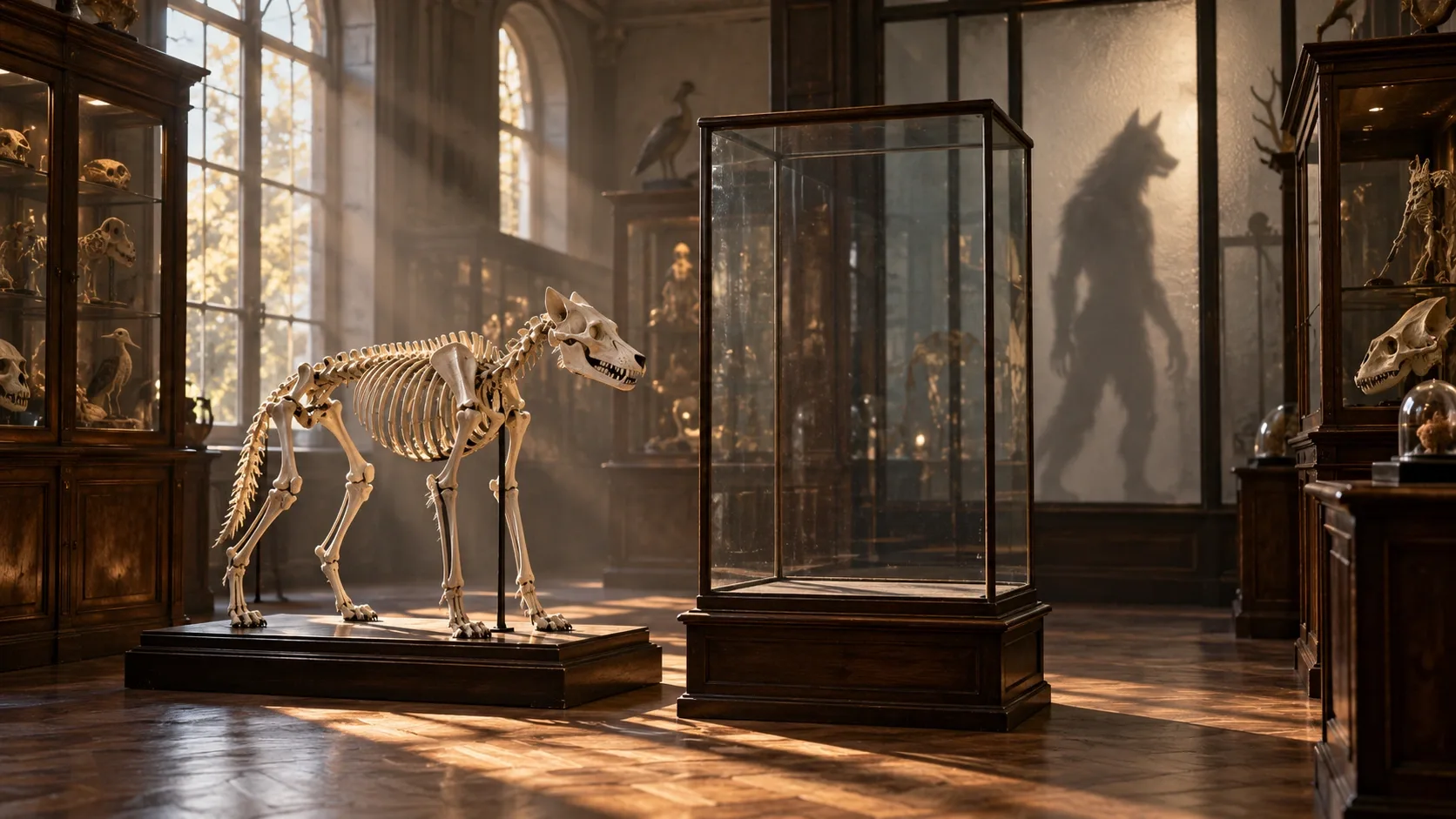
Imagined museum setting; not a photograph or reproduction of the Nantes installation.