News feature Bluff Creek / Six Rivers National Forest, Humboldt County, CA (film site); Tulsa, OK (restoration)
Tulsa Archivist Restores the 1967 Patterson–Gimlin Film — 59 Years Later, the Lookback Still Won't Sit Still
Tulsa's Todd Gatewood says he restored the 1967 Patterson–Gimlin Bigfoot film from original Kodachrome II scans; a documentary is announced for Oct. 20, 2026. Authenticity is still debated, and a cleaner scan settles nothing on its own.
Sign in to save stories to your shelf.
Timeline: the film in question was shot Oct. 20, 1967, at Bluff Creek, California. The news peg here is a Sept. 12, 2026 NewsOn6 report on a new restoration by Tulsa archivist Todd Gatewood. The documentary carrying that restore is announced for release on Oct. 20, 2026 — the 59th anniversary — which, at the time of writing, has not yet happened. A separate 2022 computational restoration and a 2026 skeptical documentary are distinct efforts, kept separate below.
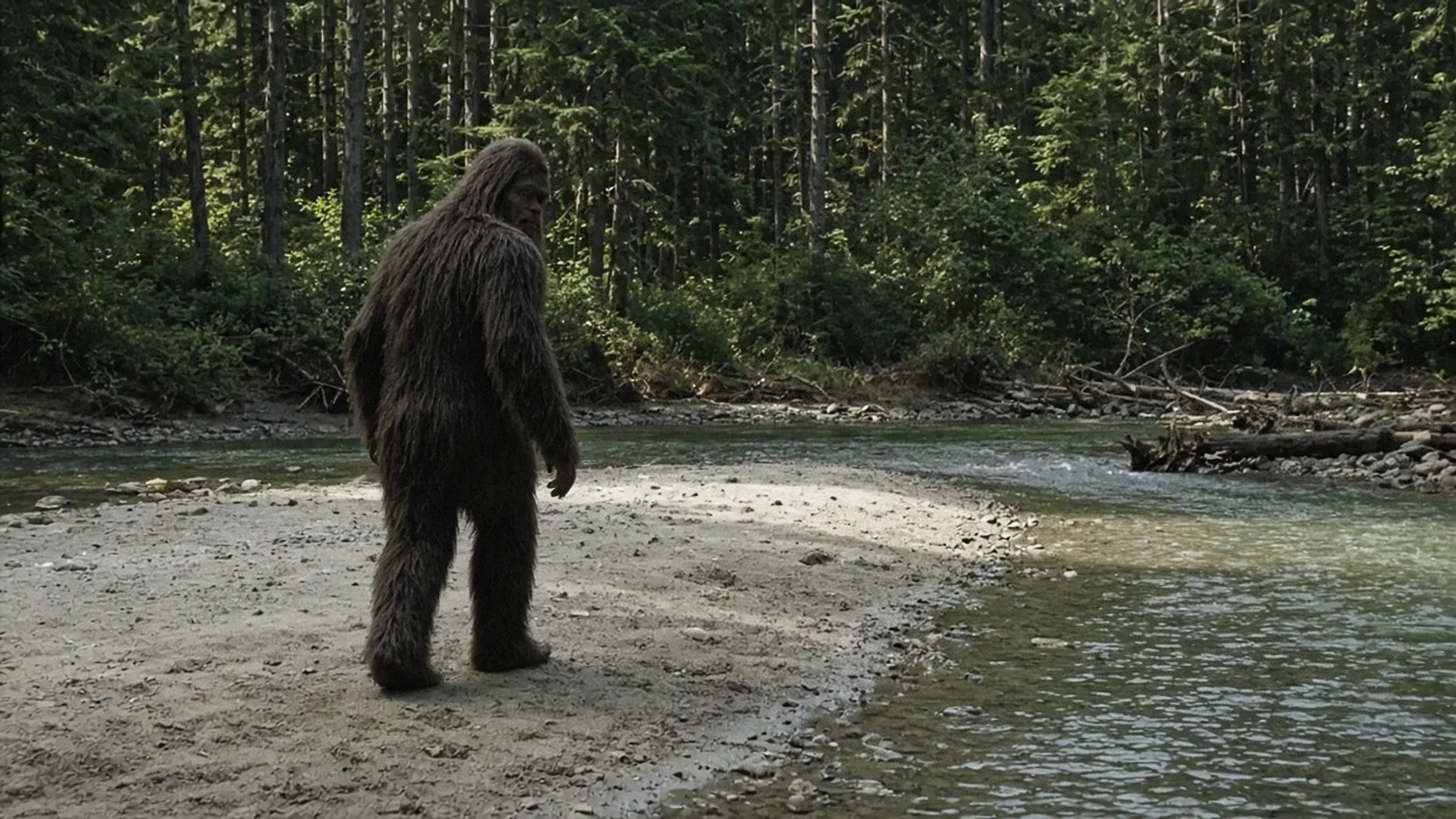
One minute of 16mm. A sandbar. A figure that turns its head.
For nearly six decades that turn — the lookback — has been the internet before the internet. Believers call it proof. Skeptics call it a suit. Hollywood makeup artists argue with anthropologists. Documentaries keep opening the same can and finding different worms.
Now a Tulsa film archivist says he has pulled the grain into museum light again.
According to a September 12, 2026 report from NewsOn6, Todd Gatewood — Tulsa native, photo archivist — completed a restoration of the 1967 Patterson–Gimlin Film from high-resolution scans of the original 16mm Kodachrome II. Announced release: October 20, 2026, the 59th anniversary of the day Roger Patterson and Bob Gimlin said they shot it at Bluff Creek in Northern California.
The package rides inside a documentary titled "Bigfoot Revealed: The Unseen Patterson–Gimlin Film." NewsOn6 says Vimeo first, major streaming later. The storefront already lives at bigfootrevealed.vhx.tv/products.
Monstrum Athenaeum has not independently verified Gatewood's scan chain, the "original" Kodachrome claim, or whether a clearer frame settles anything. As of this writing the documentary has not yet been released. Clarity is not a confession. Blur is not a conspiracy. Hold both.
October 20, 1967 — the walk that never left
According to the Wikipedia overview of the Patterson–Gimlin film, Roger Patterson and Robert "Bob" Gimlin filmed an unidentified bipedal subject alongside a Klamath River tributary in what is now remembered as Bluff Creek country — Six Rivers National Forest, far-northern California, the kind of timber that eats GPS and ghosts.
The film, Wikipedia notes, runs roughly a minute at 16 frames per second. The famous still everyone memes is commonly cited as Frame 352 — the mid-stride look over the shoulder that made "Patty" a pop-culture mammal.
Patterson died of cancer in 1972 and, Wikipedia says, maintained to the end that the creature was real. Gimlin has long denied involvement in a hoax. Critics have argued the shoot date, the costume tech of 1967, the development timeline, and the money around the reel for as long as the reel has been famous.
That is the dossier spine. Not a verdict. A cold open that refuses to cool.
Willow Creek still sells the statue. Humboldt still owns the shadow. Every new trail-cam blur from this county — including a 2026 Humboldt Reconyx claim also circulating this season — gets measured, fairly or not, against that sandbar.
What Gatewood says he did — and what he says he didn't
NewsOn6's Karen Walker quotes Gatewood drawing a hard line between restoration and remix:
"This isn't about creating a new version of the film. It's about historically preserving what was actually recorded to museum-quality standards and giving people the opportunity to examine the footage while respecting the original photographic material."
According to that report, the workflow started from high-resolution scans of the original 16mm Kodachrome II color stock — reconstruct for modern viewing, not invent detail the emulsion never held.
That sentence matters. In this field, "restored" can mean anything from a YouTube stabilization with AI goo to a peer-reviewed multi-copy composite. Gatewood, as reported, is pitching archival preservation: respect the photographic material, museum standards, contemporary access.
The documentary storefront language is hotter. The VHX product page frames nearly sixty years of mystery, eyewitness testimony, historical research, Native American perspectives, and modern technical analysis "alongside a new restoration," in marketing copy that treats Oct. 20, 1967 as the day Patterson filmed a living Sasquatch. That is documentary sales voice. It is not a lab finding. We cite it as the storefront's claim set, not Athenaeum's.
If you watch, watch for what the restore actually shows versus what the narration wants you to feel. Those are different instruments.
Do not conflate Gatewood 2026 with the Munns/math restoration
This is the part where conspiracy-curious desks earn their keep — by refusing to mash timelines into one blurry "they cleaned it up again."
A different restoration effort — not Gatewood's Tulsa project — appears in The Relict Hominoid Inquiry (2022): Isaac Y. Tian, Bill Munns, and Jeff Meldrum's paper Mathematically Optimal Restoration and Stabilization of the Patterson–Gimlin Film with Computation Feature Detection.
That work, according to the authors, did not start from a camera-original Kodachrome reel in a Tulsa vault. It merged eight independent prints of 150 frames around the lookback (Frame 354 in their indexing), photographed on a 12-megapixel DSLR from a multi-copy archive, then aligned and composited with SIFT feature matching and RANSAC homography stabilization, plus linear color correction. The point was signal-to-noise: average the copies, suppress scratches and grain unique to one print, stabilize motion without neural-net pixel invention.
They explicitly warn against AI super-resolution and frame interpolation as analysis poison — pretty playback that injects false detail. Their encode: 16 fps, 4K crop of the walk cycle, mathematical composite.
Earlier Munns/Meldrum papers in the same journal argued film-image integrity and surface-anatomy readings consistent with a biological subject rather than a 1967 suit. Those are analysis claims. They are not Gatewood's museum-preservation pitch. They are not interchangeable.
Gatewood 2026 (as NewsOn6 reports it): archival restore from high-res scans of original Kodachrome II; documentary release pegged to the 59th anniversary.
Tian / Munns / Meldrum 2022: computational multi-copy restore and stabilization of a 150-frame lookback window from second-generation-class prints; peer-journal methods paper.
Same legend. Different machines. Different source assumptions. If a comment section treats them as one project, that comment section is doing folklore, not film science.
The authenticity debate did not clock out for the anniversary
Nobody serious gets to pretend 2026 is a quiet year on this reel.
Skeptical Inquirer, in Benjamin Radford's piece on Marq Evans's documentary Capturing Bigfoot, argues the 1967 film has been revealed as a hoax, citing a belated admission from Roger Patterson's son Clint Patterson and newly surfaced 16mm footage handed to Evans in 2022 after decades in a safe. Evans's film, according to that coverage, premiered on the festival circuit (SXSW) and leans hard on provenance drama around that clip.
Believer and researcher circles have punched back on chain-of-custody, dating, and interpretation. We are not adjudicating Evans vs. Gimlin vs. Heironimus lore in one paragraph. We are noting the battlefield is live.
On the other shoulder: Munns-style costume-tech skepticism of the hoax (could 1967 fab a suit that moves like that?), Meldrum-style morphology arguments, Gimlin's decades-long insistence he saw what he saw, and a culture that built museums, festivals, and Willow Creek tourism on Frame 352.
Radford's question still cuts both ways: why is the "best" footage still from 1967? Believers answer habitat, rarity, and camera luck. Skeptics answer because the best trick only needed to work once.
Gatewood's restore does not answer that question. A cleaner Kodachrome scan can sharpen a zipper — or a deltoid. It cannot force consensus. Anyone who tells you otherwise is selling a ticket.
Bob Heironimus has long been named in hoax narratives as the man in the suit; Gimlin has long rejected that frame. Patterson is dead and cannot cross-examine a 2026 documentary. Statements made decades later are evidence of something — memory, motive, money, or truth — and those words are not interchangeable. Put them on the board. Do not pretend the board is finished.
Tech, chain of custody, and the grain of salt you should chew
Kodachrome II was not phone video. Wikipedia's long-running PGF page notes how tightly development logistics and weekend lab access have figured in timeline critiques for years. Every restoration inherits that history: who held which generation, when the camera original left whose hands, what "original" means when copies proliferated for TV and lecture circuits.
Gatewood, per NewsOn6, claims the high-res path from original stock. The 2022 Munns/Tian archive work, per that paper, explicitly worked without the camera original and treated multi-generation loss as the problem to solve. Those are opposite constraints. Respect them.
Ask, when the documentary drops:
- Are we looking at a full-reel restore or a hero sequence around the lookback?
- Is stabilization optical/archival, or computational warp?
- Did any neural upscale touch the pixels sold as "unseen"?
- Does the narration conflate Gatewood's museum language with older multi-copy science papers?
- Is "original Kodachrome II" documented with lab notes, edge codes, and chain-of-custody — or asserted in voiceover?
Conspiracy-curious does not mean gullible. It means you notice when a trailer says "revealed" and a restorer says "preserved."
A responsible restore can recover Kodachrome's saturated, fine-grained look for 4K living rooms. An irresponsible one can paint over it with generative fill and call the hallucination "clarity." Gatewood's public quotes lean responsible. Hold the finished file to those quotes.
Bluff Creek geography without the trespass fantasy
The film site sits in the Bluff Creek drainage of Six Rivers National Forest — Humboldt / Del Norte timber country, northeast of the Willow Creek corridor that branded itself Bigfoot capital. Willow Creek is the nearby regional visitor hub.
That is region precision. Not a pin for your weekend pilgrimage. Floods, re-growth, and decades of argument already ate easy landmarks; Wikipedia notes the exact site was lost for years and rediscovered in the 2010s. Private inholdings, closed gates, and Forest Service rules still apply. Do not treat an anniversary dossier as a treasure map. If you go, go legal. If you film, film from places you are allowed to stand.
Tulsa is the other geography that matters this week: Gatewood's restoration base, according to NewsOn6 — Oklahoma fluorescent light on California myth.
Why this anniversary hits different
Fifty-nine years is a weird number until you remember what the culture did with the footage. It became the default mental image of Sasquatch — gait, arm swing, mid-turn stare. TV recycled it. Skeptics dissected it. Costume designers reverse-engineered it. Every phone clip since gets measured against a sandbar most viewers will never stand on.
An anniversary restore is not neutral. It re-opens the file while selling a documentary seat. That does not make Gatewood a villain. It means the incentives stack: clearer frames drive clicks; clicks fund vault work; vault work feeds the next round of claims. Ignore that loop and you are doing fan service.
Calendar engineering is obvious: shoot anniversary equals drop date, and NewsOn6 lands the Tulsa peg well ahead of it. The VHX storefront already has buy buttons. This is a studio rollout in wilderness clothing — not a barn-find dump.
Gatewood's NewsOn6 quotes stay in preservation language — museum standards, original material, examination opportunity — not "proven biological." Hotter claims live in documentary marketing. Keep the voices labeled. A cleaner lookback that splits the internet into "zipper at 4K" versus "impossible muscle" is not restore failure. It is the same argument with better lighting.
How to watch — and what not to do
NewsOn6: restored footage will be featured in "Bigfoot Revealed: The Unseen Patterson–Gimlin Film," planned for Vimeo on Oct. 20, 2026, then later platforms. Storefront: bigfootrevealed.vhx.tv/products (check the official listing for current availability and pricing).
Watch the restore when it lands. Then watch a known multi-copy stabilization from the Munns/Tian lineage if you can find a legitimate presentation of that 2022 work. Then watch a skeptical cut of Capturing Bigfoot when it clears festivals into wider distribution. Same sandbar. Three different knives.
Do not download and re-upload "the restored PGF" to your channel like you discovered fire. Outbound fair-use links. Attribution. Let Gatewood and the rights holders fight their own distribution war.
Bottom line
A Tulsa archivist named Todd Gatewood says he restored the Patterson–Gimlin Film from high-res scans of original 16mm Kodachrome II to museum-quality standards — not a "new version," he claims — for a documentary announced for the 59th anniversary, Oct. 20, 2026.
That is a real news peg. It is not a species confirmation. It is not a hoax confirmation. It is another chance to stare at the lookback with better photons and the same unanswered question: suit, primate, or the longest-running Rorschach test in American woods lore.
Keep the Gatewood restore and the Munns/math restore in separate drawers. Salt heavily. Watch on the official storefront when it lands — and do not confuse a sharper grain with a closed case.
Sources
- Gatewood restoration complete; Kodachrome II high-res scans; museum-quality preserve (not a new version); Oct. 20, 2026 announced release; documentary title; Vimeo then major streaming — NewsOn6 / Karen Walker, Sept. 12, 2026, Tulsa filmmaker restores 1967 Patterson-Gimlin Bigfoot film
- Documentary product listing and marketing copy — VHX storefront, Bigfoot Revealed: The Unseen Patterson-Gimlin Film, bigfootrevealed.vhx.tv/products
- Classic film facts: Oct. 20, 1967; Patterson + Gimlin; the ~one-minute reel; Frame 352 lookback; Bluff Creek / Six Rivers site context; unresolved authenticity history — Wikipedia, Patterson–Gimlin film
- Distinct prior restoration: 8-copy SIFT/RANSAC composite of 150 frames around Frame 354; no AI interpolation in the main method — Tian, Munns & Meldrum, Relict Hominoid Inquiry 11:263–287 (2022), ISU PDF
- 2026 skeptical documentary claims (Capturing Bigfoot; alleged hoax admission from Clint Patterson; newly surfaced footage) — cited as competing debate, not an Athenaeum finding — Benjamin Radford, Skeptical Inquirer, Documentary's Devastating Bigfoot Debunking
This article summarizes publicly available claims for news, commentary, and criticism. Descriptions of alleged cryptid activity, film authenticity, and restoration methods are attributed to named third-party sources and have not been independently verified by Monstrum Athenaeum unless explicitly stated. Outbound links are provided for attribution and reader verification (fair-use / commentary). Video, film frames, and lengthy quotations remain the property of their respective owners; we link out rather than republish original media files. Bluff Creek regional context is not an invitation to trespass on private land or violate Forest Service closures. MonstrumAthenaeum.org is intended for mature audiences and does not claim scientific confirmation that the Patterson–Gimlin subject is a real animal or a proven hoax.
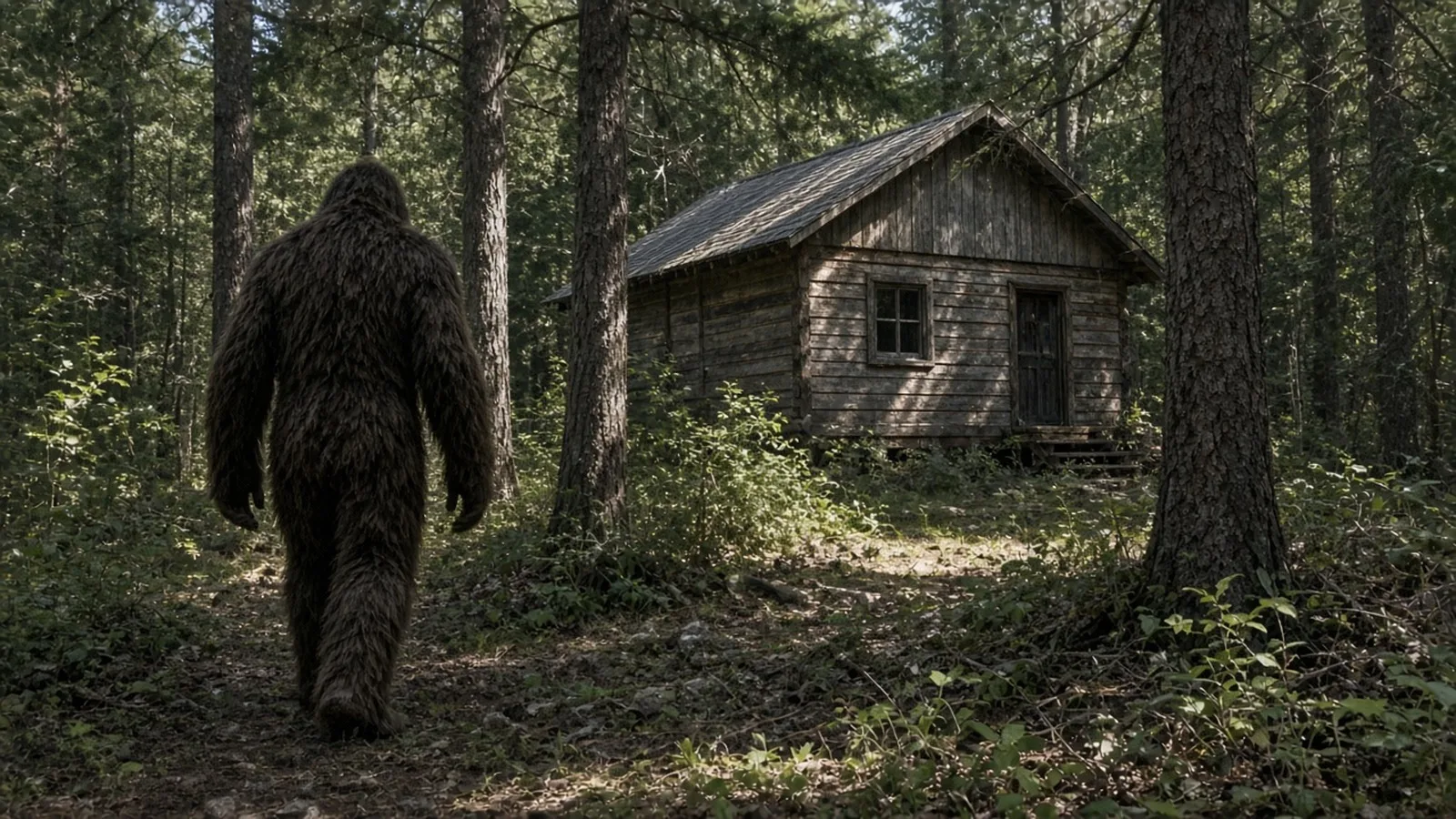
Illuminator · Conceptual illustration based on the reported description—not actual encounter footage.