
Historical / scholarly Bedburg, Rhein-Erft-Kreis, North Rhine-Westphalia, Germany; Chicoutimi (Saguenay), Quebec, Canada
Two Historical Looks at the Werewolf Idea: A 2016 Thesis on Peter Stump and an 1899 Quebec Note
A 2016 master's thesis re-examines the 1589 Peter Stump werewolf trial near Bedburg. A Quebec blogger revives an 1899 newspaper note on the loup-garou.
Sign in to save stories to your shelf.
Two 2016 items look back at how werewolf belief was recorded. One is a master's thesis that re-reads the best-known German werewolf trial. The other is a Quebec blogger's reprint of a newspaper note on the loup-garou, written 117 years earlier.
Peter Stump, re-read
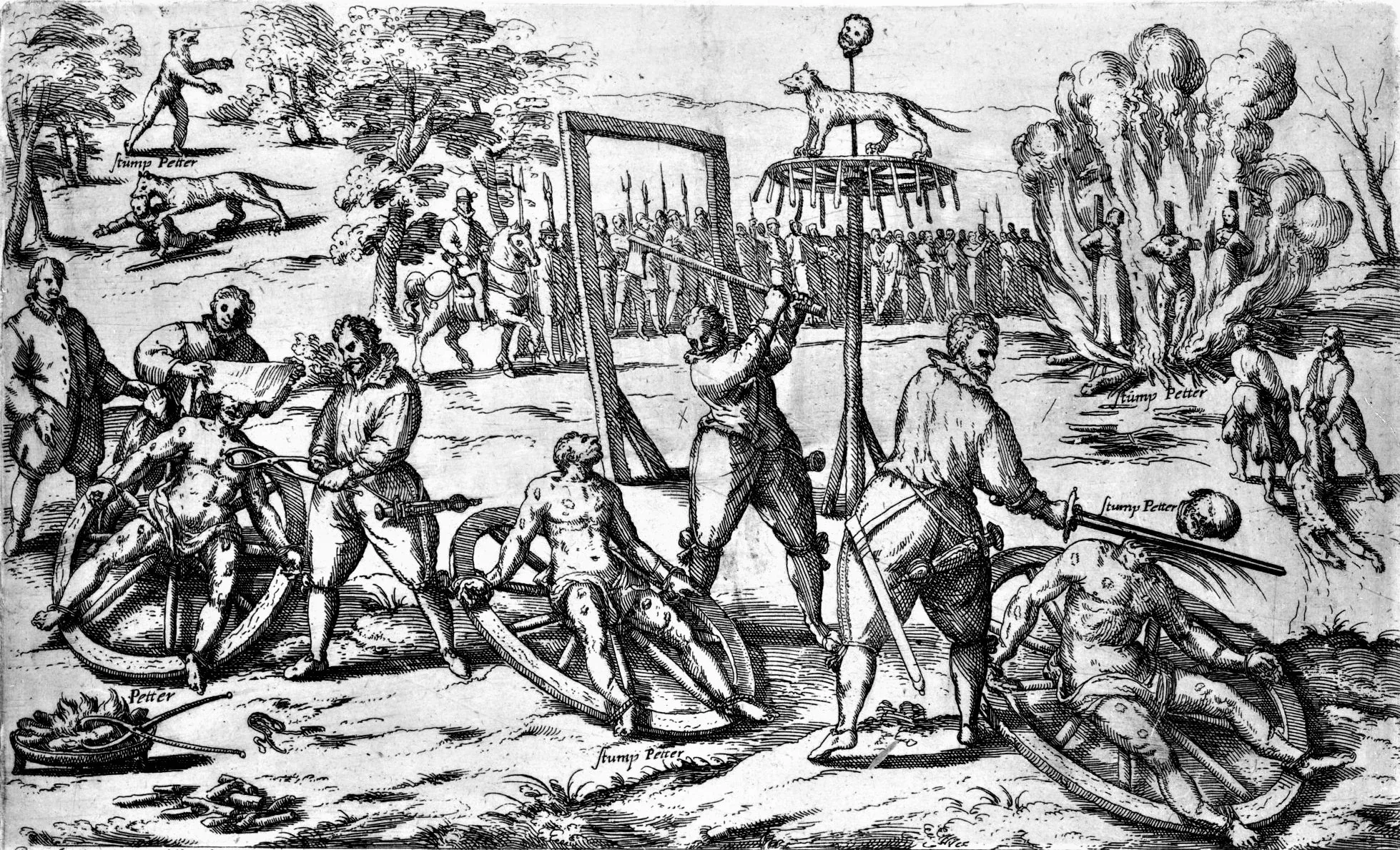
In April 2016, Lena Maria Kaiser submitted a master's thesis to the University of Duisburg-Essen, "Weil er geführt ein Wolff leben": Hintergründe, Rezeption und Deutungen des Werwolfprozesses gegen Peter Stump im späten 16. Jahrhundert. It was posted to the university's repository later in 2016. It examines the 1589 case of Peter Stump, a man tried and executed near Bedburg, west of Cologne, as a werewolf who was said to have killed over many years. The English pamphlet that spread the story gives the execution date as October 31, in a title that names "Stubbee Peeter" and accuses him of killing for 25 years.
Kaiser's conclusions, in her final chapter, are cautious:
- The case drew wide pamphlet coverage, but there is a "problematic source situation." The case "could not be conclusively confirmed" to have happened as told, because no trial files survive; she argues the lack of files is explainable and "not proof of non-existence."
- Whether Stump was a mass killer "could be neither confirmed nor refuted" from the sources. His "supposedly voluntary" confession "probably was by no means entirely of free will," and as long as it is the only proof of his deeds, she writes, it can be assumed that he confessed the murders under duress just as he confessed the wolf transformation.
- A popular theory that Stump was made a counter-Reformation example "found no tenable proof." She suggests instead that the killings attributed to him fell in a period of war around Bedburg, in the Cologne War, when soldiers and mercenaries terrorized the area, and that some of the crimes could have been committed by members of the warring parties.
- Apart from the pamphlets, the only contemporary source is the diary of Cologne chronicler Hermann von Weinsberg. He took Stump for a murderer, she writes, but doubted the magical side. About ten years later, the demonologist Martin Delrio mentioned the case as an example of imagined animal transformation.
Her own closing line is that much about Stump "must remain speculation." What the thesis establishes is the afterlife of the story: it was retold across borders in pamphlets, and four centuries on it still draws tourist trails, novels and exhibitions. For the site's earlier account, see Werewolf of Bedburg: Some Werewolf Legends Are True.
A note from Chicoutimi, 1899
On October 31, 2016, Quebec local-history blogger Jean Provencher posted "Le loup-garou," a short quotation from Sylva Clapin in the Chicoutimi newspaper La Défense of October 19, 1899. The note says that in the countryside the term once meant a person condemned after death to be changed into a loup-garou for misdeeds in life. The punishment, it says, lasted seven years and seven months and was linked chiefly to neglecting the Easter duties or to a major parish scandal.
The loup-garou ran the fields at night, the note says, and a person who met it could free the soul by tracing a large sign of the cross on it. The "malin esprit" did not let itself be approached easily, and everyone ran from a distance. Clapin writes that the superstition lasted long in Canada and "is not yet completely gone" from some remote countrysides. Provencher invites readers on remote farms to write if they have a loup-garou, adding that he is preparing three talks on the paranormal.
What the pair shows
One item doubts a famous case and the other records a belief in a living community. Together they illustrate how the same word covers different things: an accusation in a trial, and a penance in a parish. Neither supports a sighting.
Bottom line
Per Kaiser's 2016 thesis, the Peter Stump werewolf story of 1589 rests on pamphlets and a diary, its core confession was probably obtained under duress, and the existence of the case cannot be settled from surviving records. Per an 1899 Quebec newspaper item quoted in 2016, the loup-garou was understood in some Quebec parishes as a posthumous penance, not a hunted animal.
Attribution / source table
- Claim: Thesis title, university, submission date, conclusions (source situation, confession, counter-Reformation theory, Cologne War context, Weinsberg, Delrio, 'speculation')
Attribution: Lena Maria Kaiser, Masterarbeit, University of Duisburg-Essen, submitted Apr 18, 2016 (Fazit, pp. 82-85)
Link: DuEPublico PDF - Claim: Pamphlet title: 'Stubbee Peeter … 25 yeeres … executed the 31. of October last past … Bedbur neer … Collin'
Attribution: Cited in the thesis bibliography (reprinted in Summers, The Werewolf in Lore and Legend, 1933)
Link: same PDF, §8.1 - Claim: 1899 loup-garou note; seven years and seven months; signe de croix; superstition persisted
Attribution: Sylva Clapin, La Défense (Chicoutimi), Oct 19, 1899, as quoted by Jean Provencher, Oct 31, 2016
Link: Provencher - Claim: Legacy Monstrum post on Bedburg
Attribution: Monstrum Athenaeum, Nov 28, 2014
Link: Related post
Legal / disclaimer footer
Entertainment and cryptid-news commentary only. Nothing here confirms a werewolf or any other creature. Claims belong to the sources named, and fiction is identified as fiction.
Historical Peter Stumpp woodcut — unknown artist; public-domain reproduction via Wikimedia Commons, “Peter Stump crop.jpg”. Historical illustration of accusations and punishment, not evidence of supernatural events. Original lettering retained; converted to WebP.