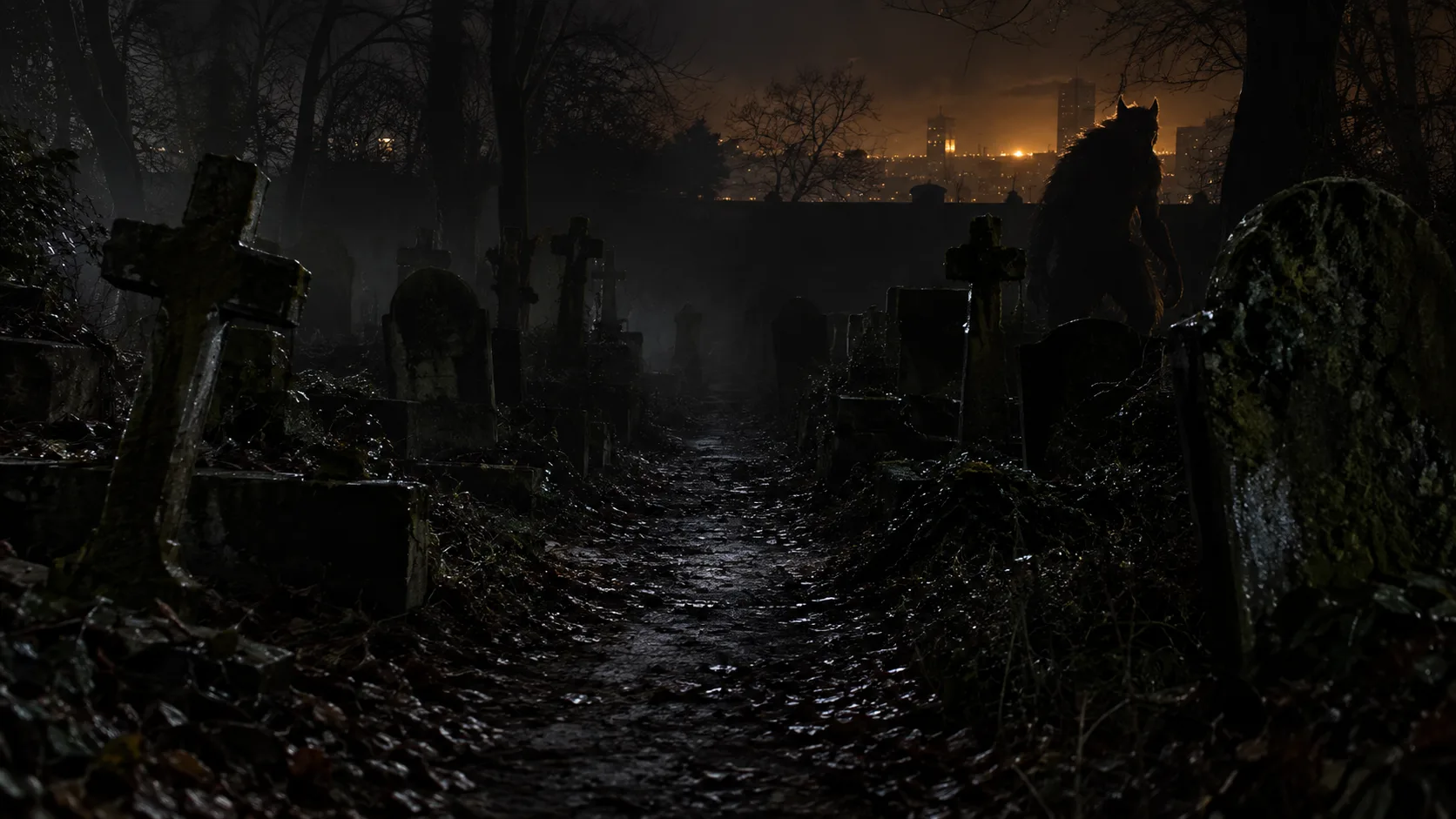
Historical report Camberwell Old / New Cemetery corridor, Southwark, southeast London, UK (Underhill Road / Brenchley Gardens approach as described in Godfrey)
Werewolf of S.E. London: Gary's Cemetery Claim, Correctly Dated (2026 Archive)
Archival 2026 feature on Linda Godfrey's “Gary” report — Camberwell Old Cemetery, 9 Oct 1996 (not 1980s). Dogman hands claim; salt. Orig. Athenaeum 2016-04-19.

Sign in to save stories to your shelf.
Warren Zevon wrote the song. South London, according to one terrified walker, tried to cast the music video.
On 19 April 2016, Monstrum Athenaeum published Was There Really a Werewolf in London In The 1980s?, summarizing a report that author Linda S. Godfrey had posted on her blog. This 2026 article is a brand-new archival feature. It keeps the story, upgrades the chronology, and refuses the predecessor's closing wink about “becoming” a werewolf.
First, fix the decade
Godfrey's post — Werewolf of (S.E.) London (5 April 2016) — states the witness etched the date as 9 October 1996. The Athenaeum's April 2016 headline and lede said mid-1980s. That was wrong relative to Godfrey's primary write-up.
2026 archival correction: treat the claimed encounter as 9 October 1996, southeast London, per Godfrey's published witness account. The song still slap. The calendar does not owe Zevon a matching decade.
Who is “Gary,” according to Godfrey?
Godfrey says the man asked to be called Gary. He was 26 at the time. He was walking to meet a friend who lived on Underhill Road. His usual bike ride was off the table that night, so he faced a long foot route past Camberwell New Cemetery, along Brenchley Gardens, and around Camberwell Old Cemetery. He chose a shortcut through the older cemetery to save maybe twenty minutes.
Dark. No flashlight. Cemetery lighting basically absent. He could see only a few feet. Folklore weather: perfect.
The attack he described
According to Godfrey's rendering of Gary's testimony:
- He glimpsed what he thought was a large dog moving fast, dismissed it as nerves, kept walking.
- Something seized his arm and forced him down — grip described as a humanlike hand, not a paw, with long clawlike nails.
- The attacker had a German Shepherd–like head and a body he compared to a Great Dane scale of mass.
- Stench: “cold and awful.” Drool. Breath in his face. A doglike sniffing inspection of his body.
- Then it broke off and sprinted into the dark.
Gary, per the account, believed an illness on him may have spoiled the meal — scent as salvation. That is his theory, not a veterinary paper on lycanthrope dietary restrictions.
Why the hand matters in dogman lore
Godfrey flagged the hand detail as rare and compelling within upright-canine encounter catalogs: paws would fit “big dog panic”; a hand pushes the report toward dogman/werewolf folklore taxonomy. Compelling for story structure. Still a single witness in the dark. Still no carcass, no film, no Met Police cryptid unit press conference.
What this desk will not do
Hard bans, said plain:
- No how-to-become-werewolf tips, rituals, bites, or cemetery pilgrimages sold as transformation tourism.
- No claim that a lycanthrope “might still be there” as actionable fact.
- No invented convictions, closures, or membership counts for London werewolf clubs.
- No after-hours trespass encouragement in burial grounds.
The 2016 Athenaeum closer flirted with “visit if you want to become.” That line is dead on arrival in this refresh. Entertainment folklore does not need recruitment copy.
Song vs. sighting
“Werewolf of London” is pop culture oxygen. Godfrey's Gary report is a 2016 publication of a 1996 anecdote. The Athenaeum's same-month echo made the meme loop tighter. A decade later, the honest SEO move is not “London werewolf confirmed.” It is “here is the dated claim, here is the dating error we fixed, here is the salt.”
Conspiracy-curious readers can ask why upright canines haunt cemeteries in testimony worldwide. Skeptics can cite darkness, fear, large dogs, and narrative contagion from a famous song. Both can leave flowers alone and gates closed.
Dogman Britain vs. American Beast of Bray Road
Godfrey's reputation was built heavily on North American upright-canine reports. A London cemetery case let her title-drop Zevon and expand geography. That editorial delight is transparent in her blog — and harmless if readers remember it is comparative folklore, not a passport stamp for a breeding population of UK werewolves.
Cemeteries as narrative machines
Burial grounds after dark compress fear: graves, limited sightlines, cultural scripts about things that should not move. A large dog off-leash, a person in a costume, or a panic misperception can all recruit the same stage. Gary's insistence on a hand fights the “just a dog” exit. That fight is why the story survives. It still does not equal laboratory proof.
Illness as plot armor
The scent-of-sickness salvation beat is memorable and ancient — predators avoiding diseased prey shows up in natural history and in folklore. As autobiography it may be sincere coping. As cryptozoology it is untested. We report it as Gary's interpretation via Godfrey, not as lupine epidemiology.
Why the 2016 Athenaeum error spread
“Werewolf in London” + “mid-1980s” is a seductive rhyme with pop memory and with other UK beast-flare eras in tabloid history. Godfrey's actual 1996 date is less singable and more accurate. Legacy refresh work exists precisely to catch those slips before they calcify into “everyone knows.”
Mature-audience closer
Read Godfrey. Stream the song. Walk London's cemeteries during permitted hours as a history visitor if you like Victorian monuments — not as a candidate for bite-initiated transformation. This desk will not romanticize assault narratives as initiation rites. Fear reported is not an enrollment form.
Bottom line
Claimed event: 9 October 1996, Camberwell Old Cemetery shortcut, SE London. Godfrey blog: 5 April 2016. Athenaeum predecessor: 19 April 2016 (with incorrect “1980s” framing). This 2026 archive: corrected timeline, retained witness details as claims, banned transformation tourism.
Salt the drool. Respect the dead. Stream Zevon instead of hopping fences.
Sources
- Claim element: Historical predecessor (2016-04-19); incorrect “1980s” framing — Attribution: Monstrum Athenaeum — Link: Was There Really a Werewolf in London In The 1980s?
- Claim element: Primary witness write-up; date 9 Oct 1996; hand/head details — Attribution: Linda S. Godfrey blog, 5 Apr 2016 — Link: Werewolf of (S.E.) London
- Claim element: Zevon cultural peg — Attribution: Pop culture reference only — Link: N/A (song title motif)
About this article
Entertainment and archival folklore commentary only — not confirmation that a werewolf or dogman attacked anyone in London, not a crime report, and not guidance on entering cemeteries after hours. Witness accounts may be sincere, mistaken, or embellished; this desk was not present in 1996. This article explicitly does not provide any method, ritual, or location guide for “becoming” a werewolf or any other supernatural identity. Do not trespass. The 2016 URL is a historical predecessor; this 2026 text is new. MonstrumAthenaeum.org is for mature audiences who can tell a song from a species.
Original publication credit
Original title: Was There Really a Werewolf in London In The 1980s?. The preserved copy has no named writer credit. Originally published April 19, 2016.