Folklore / history Torre del Lupomino, agro of Bitonto, Metropolitan City of Bari, Puglia, Italy; Cedillo and the Sierra de Gata border area, Cáceres, Extremadura, Spain
The Werewolf Tower of Bitonto and the 'Lobisome' of Extremadura: Two Southern European Legends in May 2016
A 17th-century farm tower near Bitonto is said to shelter a werewolf descended from Lycaon. A Spanish column traces Extremadura's lobisome. Both May 2016.
Sign in to save stories to your shelf.
Two regional newspapers ran werewolf folklore in May 2016, one from southern Italy and one from the Spanish-Portuguese border. Neither is a sighting. Both are collections of what older residents say, which is what makes them worth reading closely.
A tower near Bitonto
On May 30, 2016, the Bari news site Barinedita published "Torre del Lupomino" by Massimiliano Fina. The tower is an abandoned 17th-century farm building south of Bitonto in Puglia. According to the legend, its one resident descends from a Greek king and turns into a wolf every full moon.
The article gives two ideas for the name. One is "lupomn," a local dialect word for a werewolf. The other is the Lupis, a noble family present in the Bari area since the 1200s that probably owned the building. Whatever its origin, Fina writes, the story says the resident inherited a curse from the mythical Lycaon of Arcadia. In that tale Zeus visited Lycaon's court disguised as a beggar and was served the flesh of a slain slave. As punishment, Lycaon was turned into a wolf at every full moon, and the curse passed to his descendants, among them Peucetius, to whom the story gives control of Puglia. The tale has been "absorbed" by Christianity, Fina adds, with the werewolf seen as the devil's work.
Two local people speak. "Rosina" says that when she was young "you always heard noises and howls" near the tower, and that fellow farmhands who liked to scare others blamed "the lupo mannaro." "Peppino," 70, recalls his grandfather's stories of "a long series of murders and attacks" and a supposed meeting with a huge man-like figure running on all fours and growling, which his grandfather escaped by climbing a tree. Neither account is dated, and neither is firsthand on the events.
Fina visited the site, noted a recently placed signpost, an arched press-house once used to crush grapes, and a vaulted room with niches, a fireplace and a slit window. "Of wolves," he writes, "not a trace." He suggests returning on the next full moon, June 20. The U.S. Naval Observatory's table confirms the full moon fell that day, June 20, 2016, at 11:02 UTC.
A reader comment under the article, signed Pasquale Fallacara, supplies a more mundane history. It dates the structure to the early 1600s, in the Lago di Chitro district on the old Palo road, and describes it as a custodian's night lodging and a wine cellar beside a grape press. It states that "the oldest Bitontini recall distressing close night encounters with 'u lpomn'" but judges the name "more probably" derived from the Lupis family, recorded in Bitonto since the 16th century. The comment is undated and we cannot confirm who wrote it.
The lobisome of the Spanish border
Three weeks earlier, on May 9, 2016, the Extremadura paper Hoy ran Israel J. Espino's column "El hombre lobo extremeño: Cómo convertirse en lobisome." It says the region's werewolf was known, "according to the great Publio Hurtado more than a century ago," as the "lobushome" or "lobisome," as in Galicia and Portugal. The legend arrived from Galicia through Portugal, Espino writes, and is most abundant in the villages of La Raya, the border strip, spreading inward with "the help of full-moon nights."
As evidence he cites a song, "Mae Bruxa," collected by José Tomás Sousa in Cedillo, a Sierra de Gata village on the border whose people speak a Portuguese dialect, and "rescued" by Acetre. Its refrain links the werewolf to witchcraft: "Tua mãe é bruxa… teu pai lobisomem" ("your mother is a witch… your father a werewolf"). The page we could read is a teaser; the full column is on the blog Extremadura Secreta, which we did not open.
What the two items show
Both pieces treat the werewolf as inherited speech and song, not as an event. Bitonto's version borrows a Greek myth and a family name. The border version borrows a language. They are useful as evidence of how long the idea has lived in these places, not of what, if anything, walked there.
Bottom line
Per Barinedita, a ruin near Bitonto carries a local legend of a Lycaon-descended werewolf, backed by two undated oral memories and no physical trace. Per Hoy, Extremadura's "lobisome" belongs to the Galician-Portuguese tradition and is strongest on the Portuguese border. Neither source describes a recent encounter.
Attribution / source table
- Claim: Torre del Lupomino: 17th-century tower; name theories; Lycaon/Peucetius legend; Rosina and Peppino; visit; June 20 full moon
Attribution: Massimiliano Fina, Barinedita, May 30, 2016
Link: Barinedita - Claim: Reader comment on structure, Lupis family, local memory (undated, author unverified)
Attribution: Comment signed Pasquale Fallacara under the Barinedita article
Link: Barinedita comments - Claim: Extremadura 'lobisome': Publio Hurtado, La Raya, Mae Bruxa (Cedillo)
Attribution: Israel J. Espino, Hoy, May 9, 2016 (teaser; full text on Extremadura Secreta)
Link: Hoy - Claim: Full Moon June 20, 2016, 11:02 UTC
Attribution: U.S. Naval Observatory (API, checked 2026-10-28)
Link: USNO - Claim: Legacy Monstrum post on Bedburg
Attribution: Monstrum Athenaeum, Nov 28, 2014
Link: Related post
Legal / disclaimer footer
Entertainment and cryptid-news commentary only. Nothing here confirms a werewolf or any other creature. Claims belong to the sources named, and fiction is identified as fiction.
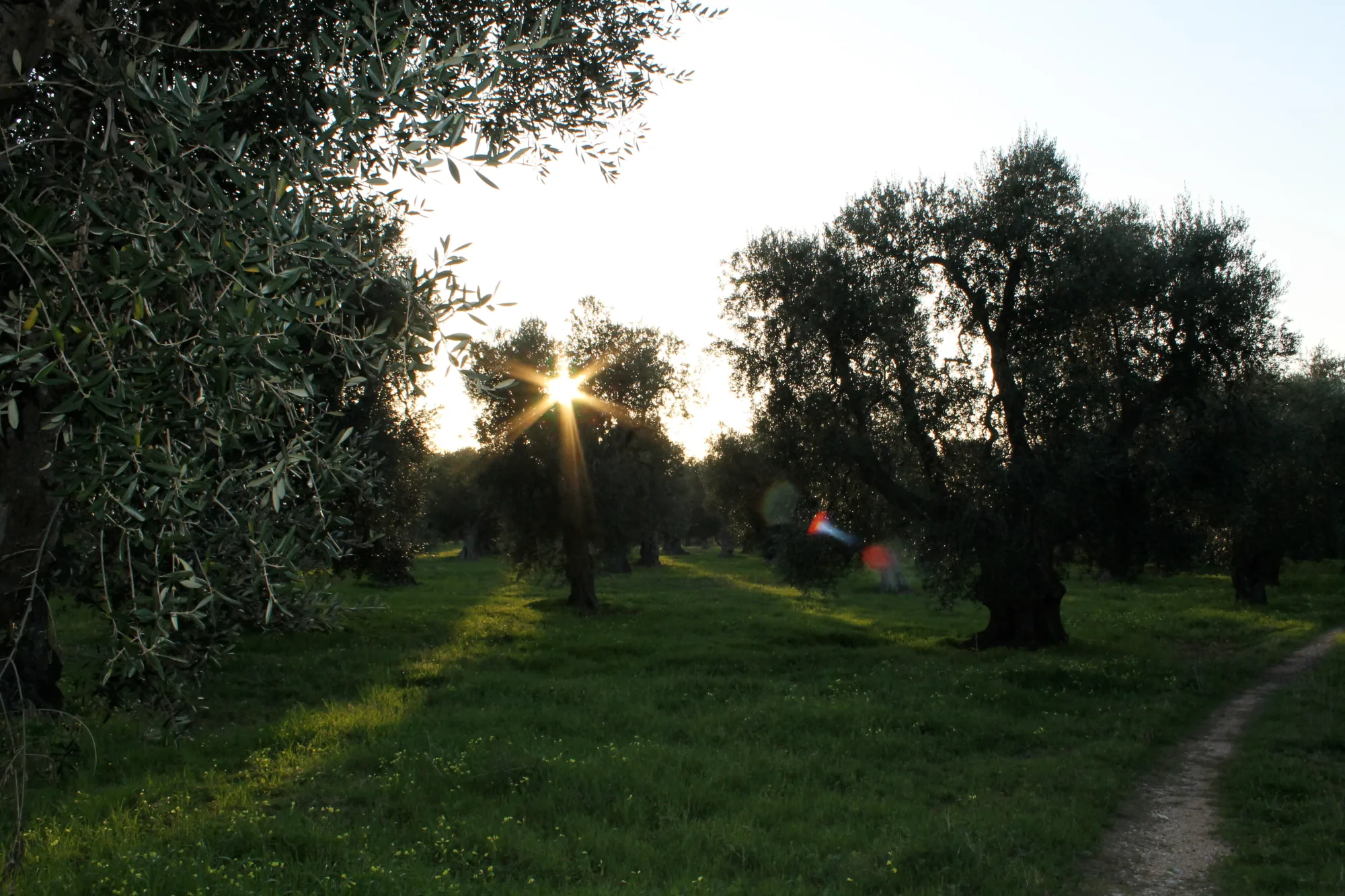
Olive Groves in Puglia Countryside (2012) — Patrick Nouhailler, via Wikimedia Commons. CC BY-SA 3.0: https://creativecommons.org/licenses/by-sa/3.0/ . Regional context near Vieste, not the Bitonto tower. Converted to WebP; composition unchanged. This image remains under CC BY-SA 3.0.