Archive article Monstrum Athenaeum
Did Google Earth Inadvertently Capture Kraken Footage?
Google Earth is an awesome tool for checking out the world from high above. On occasion, though, strange images pop up leaving us scratching our heads, speculating as to what the mystery could be. Case in point, a curious picture was taken…
Sign in to save stories to your shelf.
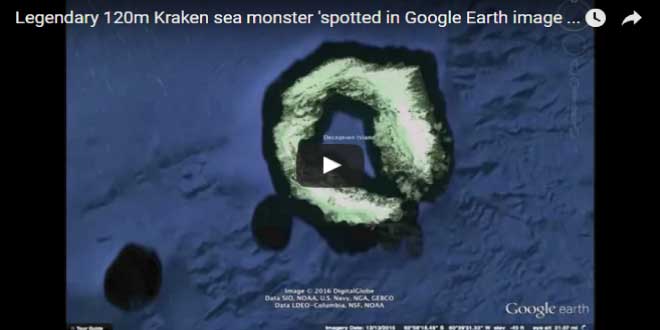
Google Earth is an awesome tool for checking out the world from high above. On occasion, though, strange images pop up leaving us scratching our heads, speculating as to what the mystery could be. Case in point, a curious picture was taken near Antarctica that has many claiming proof ‘sea monsters’ exist.
The staff at UFO Sighting Daily reviewed the footage and suspected it could well be something along the lines of the Kraken. Based on their calculations, they estimated the creature was 30 meters in length (100 feet) but note the tale-end resembles a giant squid. If this creature is a cephalopod, the total length could be closer to 60 meters with tentacles.
The description matches loosely the mythical Kraken, a sea monster notorious for destroying ships and drowning sailors. Prowling the seas off the coast of Norway and Greenland, recorded legends of the Kraken in Old Icelandic sagas date back to the late 13th century. Carolus Linnaeus classified the Kraken in 1735 as a cephalopod and gave it a scientific name, Microcosmus marinus, in his first edition of Systema Naturae.
Despite a resemblance, the cryptid community isn’t settled in agreement Google Earth captured Kraken footage. Parallels have been drawn to photos of the Loch Ness Monster while others say they see an underwater UFO. Skeptics, on the other hand, are quick to point out the image could be nothing more than a blue whale.
Article details & credits
Original title: Did Google Earth Inadvertently Capture Kraken Footage?. Originally published June 29, 2016.
