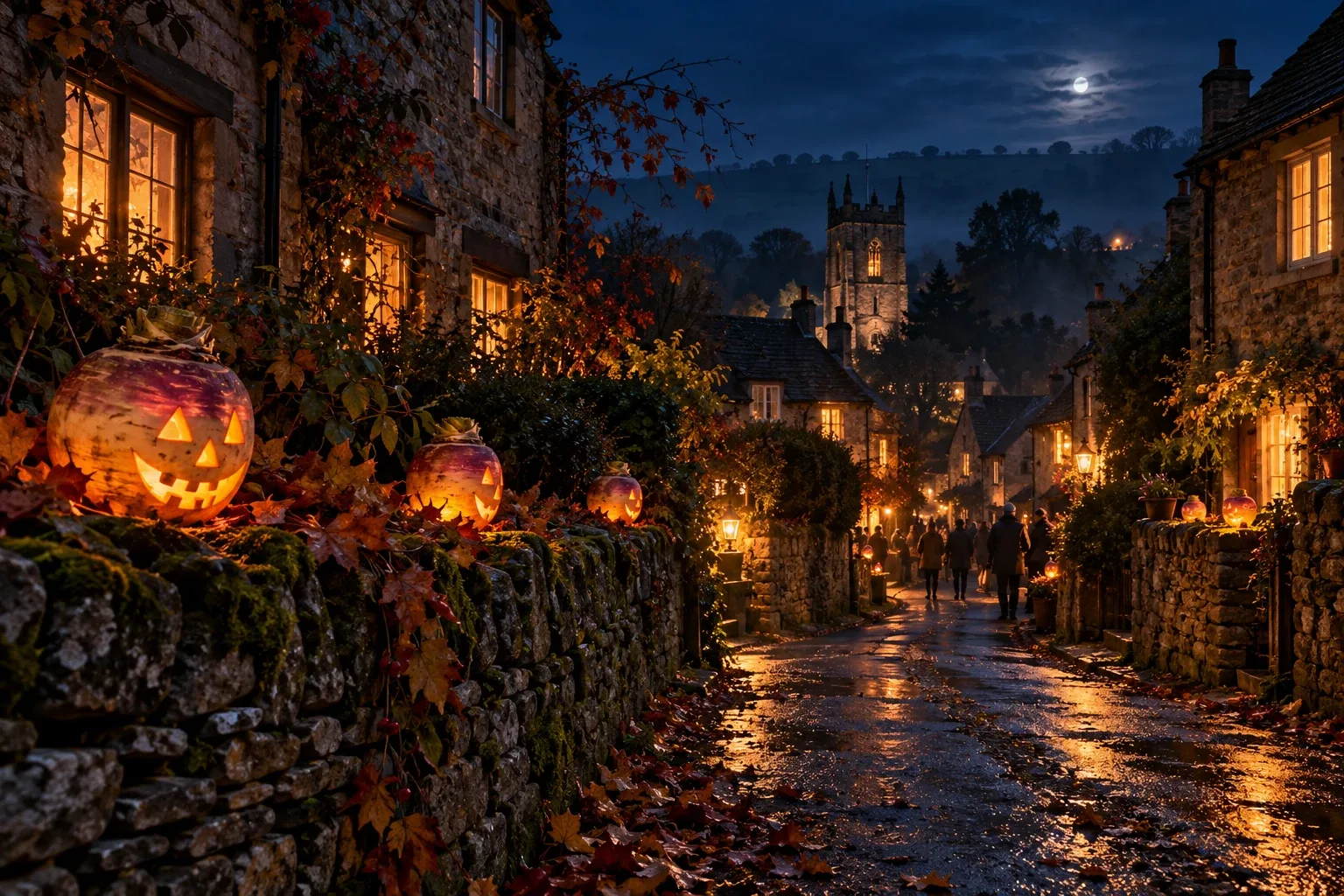
Folklore and cultural history Salem, Massachusetts, USA (Halloween witch-icon tourism / witch-panic echo)
Witches, Brooms, Cauldrons: How Halloween Stole Its Icons
Brooms were housework. Cauldrons were dinner. Halloween turned them into a fear kit. Here’s how witch iconography got built—and borrowed—for October 31.
Sign in to save stories to your shelf.
Halloween’s witch kit looks ancient.
Most of it is rebranded housework.
History.com’s “Why Witches Fly on Brooms” feature, National Geographic’s witches’-gear history, and related explainer journalism walk the same unsettling aisle: ordinary women’s tools — broom, pot, hat — get pulled into demonological fantasy, early modern image culture, and finally October retail.
No claim here that “real witches” clock air miles. The claim is about iconography: how fear learned to recognize itself at a glance.
The broom — flight as accusation tech
Brooms were standard domestic gear. That matters. Accusations loved proximity to women’s labor.
History.com and The Conversation’s historian unpacking of broomstick flight describe a medieval-to-early-modern invention stack: anointed staffs, hallucinogenic ointment lore in demonological texts, skeptical pushback even then, and early images such as illustrations associated with Martin Le Franc’s fifteenth-century manuscript tradition showing aerial women.
Popular tellings often add the ointment-on-the-stick innuendo. Treat eroticized demonology as period propaganda, not a how-to. Monstrum’s hard rule: no ritual recipes, no ingestible instructions — just the historical claim that flight stories were told, printed, and feared.
By the time Halloween postcards need a silhouette, the broom is already the airline.
The cauldron — dinner pot meets Macbeth PR
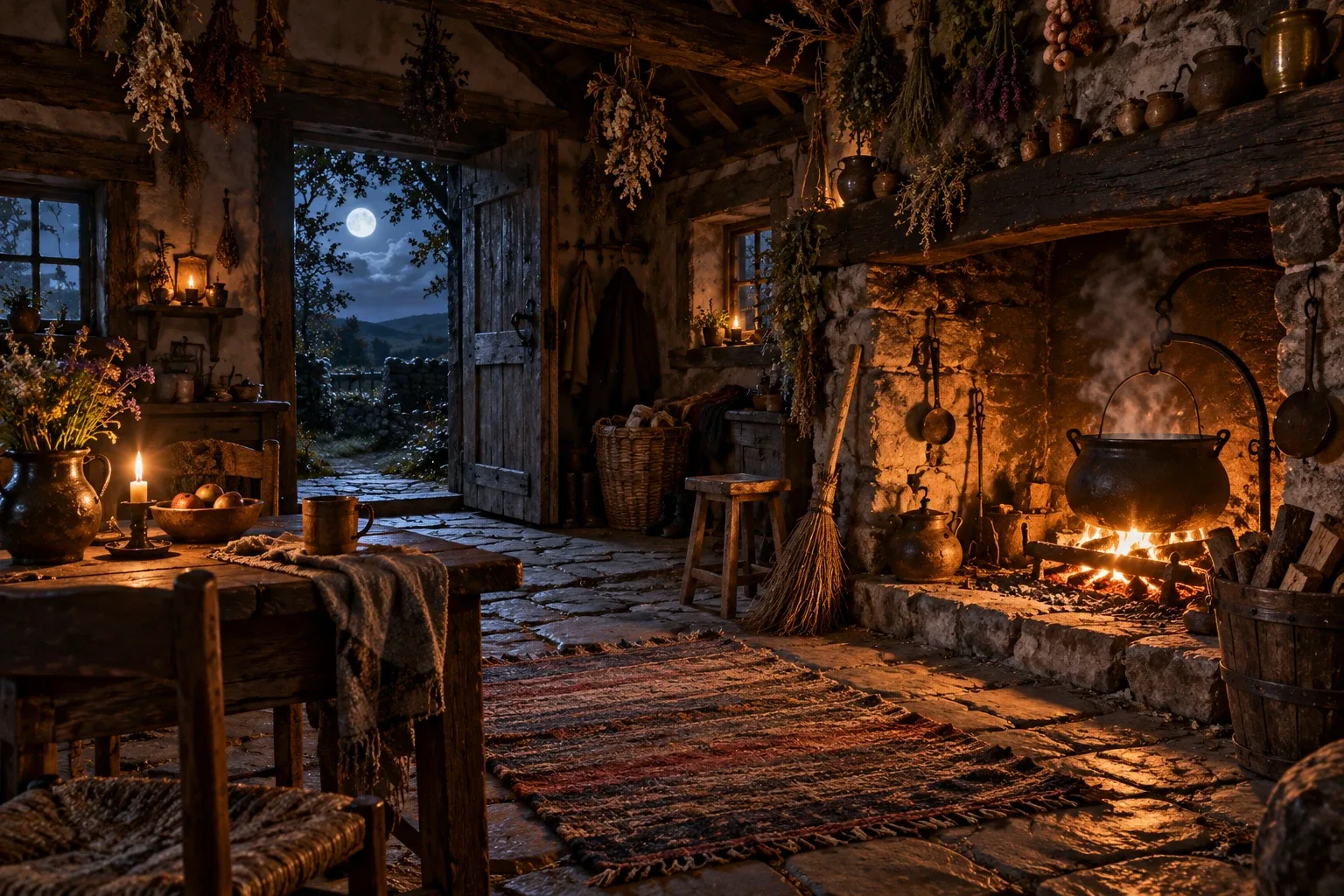
Cauldrons started as cooking and healing vessels — household industrial equipment. NatGeo’s gear piece traces how they acquired sinister charge in Renaissance art and stage culture.
Shakespeare’s Macbeth didn’t invent witch cauldrons, but it gave English-speaking memory an unforgettable ad jingle: “Double, double toil and trouble; Fire burn and cauldron bubble.” Theater turned a kitchen object into a portal prop. Halloween merchandising never looked back.
A darker reading: criminalize the pot where women cooked medicine, then sell plastic versions to children annually. Culture’s dark jokes write themselves.
The hat — pointy shorthand
History.com’s witch-hat origins piece tracks how the pointy hat became costume canon — a mix of earlier European hat styles, antisemitic and outsider caricature debates in scholarly discussion, golden-age illustration, and twentieth-century costume industry lock-in.
Exact genealogy is contested; visual usefulness is not. A triangle on a head reads “witch” at fifty yards. Halloween needs that kind of brutal semiotics.
How October stole the set
Samhain-season fear of wandering spirits and fairy danger didn’t require a Disney witch. Allhallowtide pageants could costume saints and demons without a broom airline.
The American Halloween witch is a later collage:
- Early modern European witch-hunt imagery
- Romantic and Victorian gothic revival
- Children’s book illustration
- Postcard and party-store standardization
- Film: from silent-era hags to green-skinned icons
Salem, Massachusetts — used here as witch-panic echo geography, not as broom factory — commercialized the silhouette into destination tourism. The town’s October economy is partly a museum of icon survival.
What got erased when the icons hardened
Real accused people. Ordinary herbalists. Midwives. Neighbors with bad timing. Men and women caught in property disputes and religious panic.
Halloween’s cute witch can accidentally launder that history into sparkle. The job is to keep both frames visible: enjoy the silhouette, remember it was once evidence in a killing season.
Familiars and the supporting cast
Black cats, toads, owls — the petting zoo of accusation — ride shotgun. The path-crossing omen is its own story, and so is the full history of familiars. Here, just note: icons travel in packs.
Green skin, long nose, and the cartoon upgrade
Twentieth-century animation and film finished what pamphlets started: a reproducible witch face you could franchise. Green skin isn’t medieval trial testimony; it’s makeup and celluloid choice that stuck. Once kids can draw the archetype from memory, the icon has won.
That win is double-edged. It makes Halloween legible worldwide. It also flattens diverse folk magical figures — Irish cailleach echoes, cunning folk, fairy queens — into one broom-branded product line.
Male witches and the missing half of the poster
Early modern trials accused men too. English “witches,” continental Hexen, and colonial cases weren’t exclusively female. Halloween’s default casting — almost always a woman — preserves the gendered panic more faithfully than the full court record.
Iconography is an editor. Editors cut.
Why the stolen-tools thesis matters
If the broom and cauldron began as domestic gear, then witch iconography is partly a library of criminalized women’s work. Halloween’s joke inherits a paperwork trail of control: who cooks, who heals, who sweeps, who gets called dangerous for doing it wrong — or doing it independently.
You can still hang a plastic cauldron on a door. Just know what you’re hanging.
Demonology’s illustrated users’ manual
Early modern Europe didn’t only preach against witches. It published them. Treatises, pamphlets, and woodcuts taught readers what a witch should look like doing — riding, stirring, meeting at night. Once the visual syllabus existed, accusations and art could quote each other.
The Conversation’s broomstick essay is valuable because it includes contemporary skepticism: not everyone bought flight stories even then. Halloween rarely reprints the skeptics. It reprints the silhouette.
From sabbat fantasy to sidewalk costume
The leap from demonological sabbat fantasy to a six-year-old in a cone hat is the whole Halloween trick. Fear becomes play without fully deleting the fear.
Parents who ban witch costumes as “occult” and parents who buy glow-in-the-dark cauldrons are arguing over the same inherited props. Allhallowtide once tried to baptize autumn dead-customs; Halloween baptized the witch kit into comedy — incompletely.
Cauldrons in the Samhain neighborhood (carefully)
Gaelic myth and later folk practice have their own vessels, feasts, and fire logic — see our Samhain feature — but equating every pot with a Macbeth prop is sloppy. The Halloween cauldron is mostly English-stage + retail. If your path uses a ritual cup or feast pot at Samhain, that’s a living religious practice, not a Spirit Halloween SKU. Keep the categories honest.
Field guide to the stolen kit
- Icon: Broom
Mundane origin (claim): Sweeping / domestic staff
Fear upgrade: Flight / night travel
Halloween job: Instant witch signal - Icon: Cauldron
Mundane origin (claim): Cooking / brewing
Fear upgrade: Poison / prophecy brew
Halloween job: Bubbling set piece - Icon: Pointy hat
Mundane origin (claim): Contested fashion history
Fear upgrade: Outsider mark
Halloween job: Costume crown - Icon: Black cat
Mundane origin (claim): Pet / mouser
Fear upgrade: Familiar / Devil mask
Halloween job: Sidekick omen
Sources: History, NatGeo, Britannica cat pages — popular synthesis, not a museum catalog accession number.
Bottom line
Halloween didn’t invent the witch.
It shoplifted a fear kit built from women’s tools, demonology pamphlets, and stage poetry — then sold it back as October cosplay.
Brooms sweep. Cauldrons cook. Hats keep off rain. Fear taught them to fly, bubble, and menace. Take the flight logs with salt.
Attribution / sources
- Claim element: Broomstick flight folklore / image history
Attribution: HISTORY.com, why witches fly on brooms
Link: history.com/articles/why-witches-fly-on-brooms - Claim element: Historian unpacking of broomstick invention/skepticism
Attribution: The Conversation
Link: theconversation.com/can-witches-fly-a-historian-unpacks-the-medieval-invention-and-skepticism-of-the-witch-on-a-broomstick-222472 - Claim element: Brooms, cauldrons, hats as gear history
Attribution: National Geographic witches’ gear
Link: nationalgeographic.com/history/article/witches-gear-broomstick-hat - Claim element: Pointy hat costume origins
Attribution: HISTORY.com witch hat
Link: history.com/articles/witch-hat-costume-origins
Protective footer
This article is entertainment and folklore commentary for a mature audience. It summarizes publicly available historical claims about witch iconography. It is not historical, religious, or occult instructional advice. It does not provide ritual recipes, ointments, or any dangerous practice guidance. Folklore and demonological texts should be taken with a grain of salt. Links are for attribution and verification.
Dramatic recreation — Monstrum Athenaeum