Cultural history Brazil
Janaina Wagner’s Lobisomem: The Werewolf in Iron and Film
The Brazilian artist's recurring werewolf appears in two guises — a short film and a small metal engraving — and even its date resists a single answer.
Sign in to save stories to your shelf.
A werewolf does not have to arrive with teeth bared. Sometimes it arrives as a title on a small piece of iron.
Brazilian artist Janaina Wagner has used Lobisomem — Werewolf — for works in more than one medium. The 2021 SUPER-NATURAL exhibition captions identify a 2016 iron engraving measuring fifteen by twenty centimeters. The modest object carries a name associated with a much less containable body.
There is also an eighteen-minute moving-image work. Wagner’s current filmography dates that Lobisomem, produced through Bolsa Pampulha, to 2017. Pivô’s exhibition material dates the video to 2016. Those differing catalog dates remain unresolved; the engraving and film should not be confused with one another.
A name moving between materials
Wagner’s filmography returns to transformation imagery with the later title Licantropia. It is a recurring vocabulary rather than an isolated use of a familiar monster’s name.
An engraving fixes a mark in a material. A film lets an image pass through time. Bringing the werewolf’s name to both forms creates an apt tension between what can be held still and what keeps changing. The association is especially suggestive in iron: the creature known for an unstable body acquires a hard surface and a small, definite set of dimensions.
Here the lobisomem belongs to an artist’s practice and the exhibitions that carry it. Its passage between object and moving image offers another way into the figure, away from the expectation of a creature finally stepping into view.
Sources
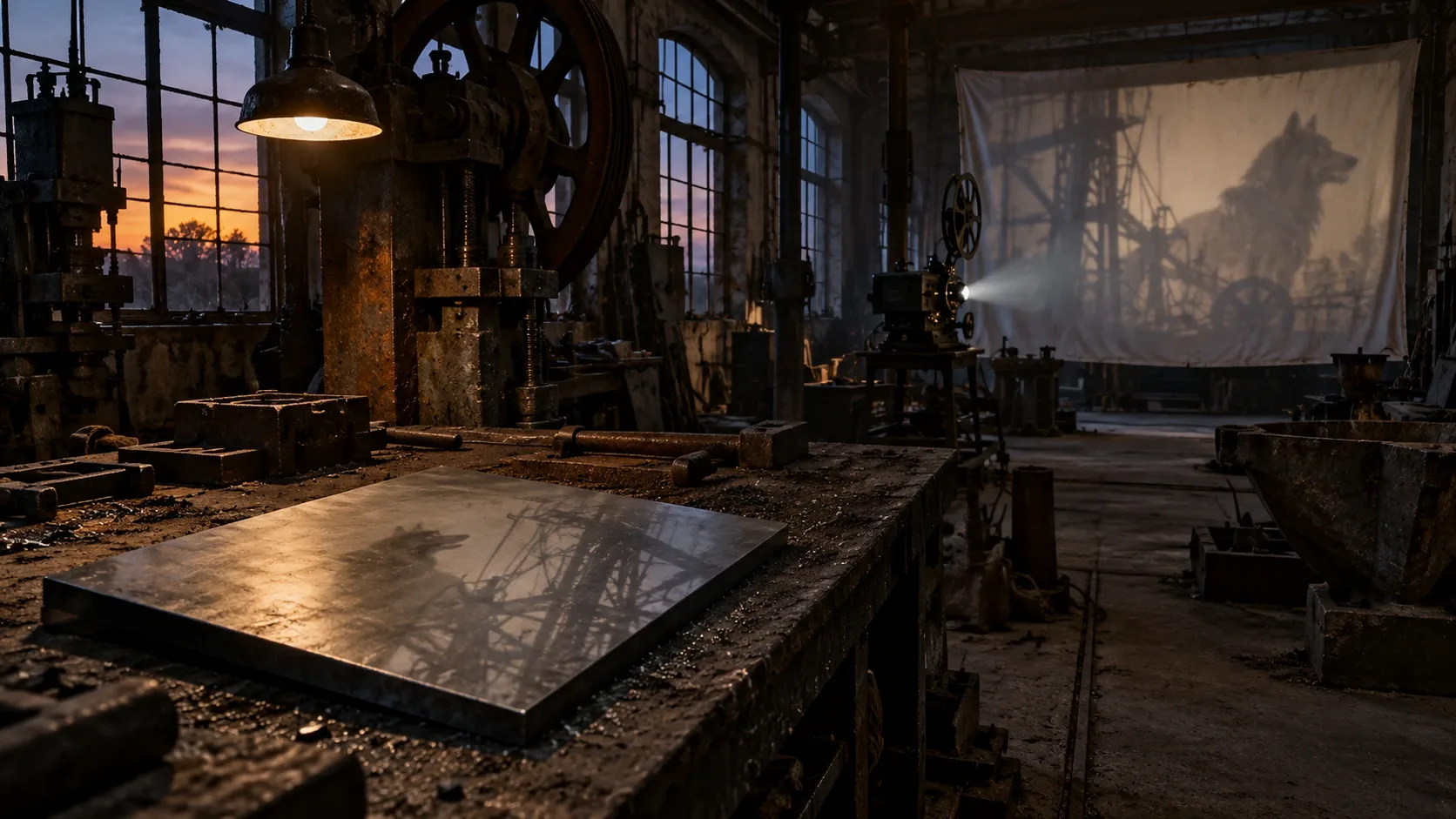
Original thematic illustration; not source film footage, book art or an actual venue.