Historical report Swansea / Lake Macquarie, New South Wales, Australia (Swansea boat ramp corridor)

Lake Macquarie “Sea Monster”: When a Pike Eel Broke the Internet (2026 Archive)

Archival 2026 feature on the Feb 2016 Swansea / Lake Macquarie NSW wash-up ID'd as a pike eel by Mark McGrouther et al. Panic vs taxonomy. Orig. 2016-04-04.

By Cryptid deskFirst published Updated 6 min read
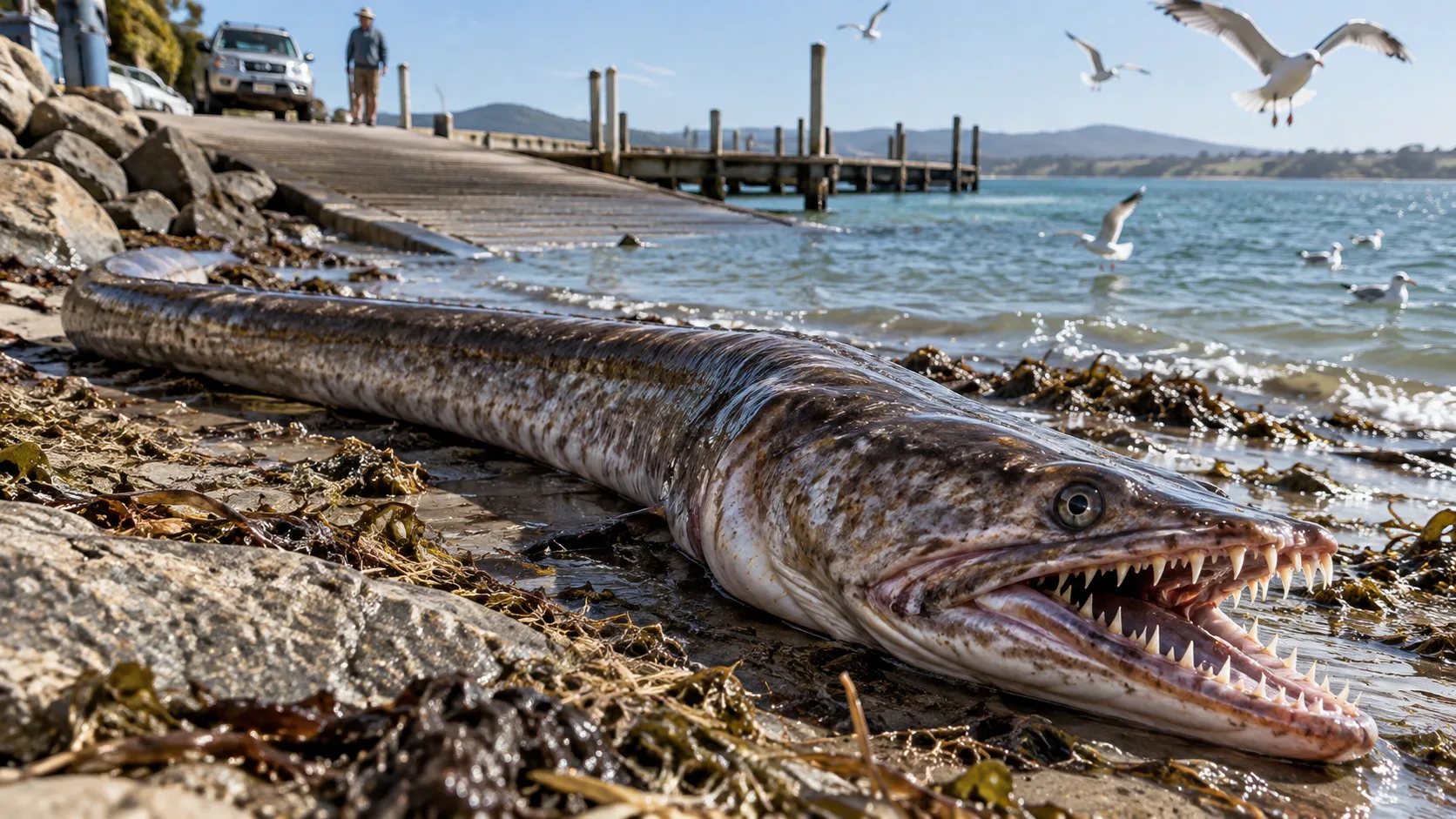
An Australian lake-mouth boat ramp at Swansea in morning light, a long sharp-toothed eel-like carcass sprawled on wet sand and rock near the water, gulls circling, the tide line littered with weed — a real dead animal that panic turned monstrous.

Sign in to save stories to your shelf.

Sometimes the cryptid is a camera angle with teeth.

On 4 April 2016, Monstrum Athenaeum published Mysterious Sea Creature Appears on Australian Beach, recycling a February social-media freakout from Lake Macquarie, New South Wales. (The 2016 headline text mangled the place as “Make Macquarie” — we correct the spelling here without pretending the predecessor never slipped.) This 2026 article is a brand-new archival feature that keeps the panic, then keeps the identification.

February 2016: the photo that asked “what the hell?”

Photographer Robert Tyndall documented a long, sharp-toothed carcass near the Swansea boat ramp. The image, shared online (notably via Ethan Tippa's Facebook post in period coverage), detonated the usual comment bouquet: messed-up crocodile, dolphin-croc hybrid, Photoshop, lake monster, hairtail, edit job.

Dead animals on beaches are common. Viral certainty is rarer — and louder.

Experts enter, romance exits

According to contemporary reporting from the Sydney Morning Herald, Newcastle Herald, UPI, and others:

  • Mark McGrouther, then ichthyology manager at the Australian Museum, identified the animal as a pike eel (Muraenesox bagio).
  • Pike eels inhabit Australia's east coast waters; they can approach roughly 1.8 meters (~6 feet). McGrouther noted the photo angle likely inflated the drama.
  • Tyndall himself later said the specimen was about 1.4 meters (~4.5 feet) — big eel energy, not kaiju.
  • NSW Department of Primary Industries commentary in period pieces treated it as a mature pike eel, possibly dead of natural causes; biologists also floated net entanglement or boat strike as mundane endings.

McGrouther's “rarely seen in the flesh” color — nocturnal, deeper-water habits — explains why a known species still felt cryptid to a boat-ramp crowd. Rarity of encounter ≠ unknown to science.

What the 2016 Athenaeum piece emphasized

The predecessor leaned into confusion and stacked other Australian oddities — goblin shark and frilled shark catches — as proof the ocean still mints “almost mythical” animals. Fair vibes. Incomplete ending. By the time Athenaeum posted in April, February's news cycle had already moved from “mystery” to “pike eel.” A 2026 archive that soft-pedals the ID would be nostalgia cosplay.

Status check: As of this 2026 rewrite, we are not claiming a continuing unidentified Macquarie monster. The famous photo incident is historically tagged as misidentified pike eel in mainstream coverage. That is the verified lane.

Cryptid lesson hiding in the gills

Previous generations might have filed deep-water oddities as sea serpents because taxonomy lagged behind nets. Today the gap is often media literacy: a wide-angle corpse plus Facebook equals temporary dragon. The frilled shark and goblin shark examples still matter — they are real, rare-looking fish that shock people — but they do not resurrect this particular carcass as an unknown species.

Conspiracy-curious coda (salted)

Was it edited? Tyndall, per local press, laughed that off — he claimed he barely knew computers. Could experts be wrong? Always possible in principle; here multiple voices (museum ichthyology, DPI, independent marine biologists quoted in SMH/Herald) converged. Could a “cover story” hide a hybrid horror? That theory needs more than a boat-ramp JPEG.

Why wash-ups go viral faster than taxonomy

A living pike eel at depth is a fishing story. A dead pike eel at a boat ramp is a content object: teeth visible, body elongated, context removed. Social media rewards the question “what is it?” more than the answer “Muraenesox bagio.” By the time experts reply, the screenshot has already emigrated to three continents and a thousand group chats.

Camera angle as cryptid technology

McGrouther's point about perspective is the quiet star of this file. Forced perspective turns a 1.4-meter eel into a shoreline dragon. The same trick inflates fish on docks worldwide. Knowing the trick does not make the teeth less sharp. It makes the headline less honest if you omit it.

Goblin sharks and frilled sharks — useful, not exculpatory

The 2016 Athenaeum piece was right that Australia's waters still produce rare, unsettling animals. Goblin sharks and frilled sharks look prehistoric because evolution kept workable weirdness. They demonstrate incomplete public familiarity, not a failure of science to name the Swansea specimen. Once McGrouther and colleagues spoke, the Macquarie carcass exited the cryptid column — or should have.

Editorial ethics for “mystery animal” posts

Best practice in 2026: if mainstream experts ID a wash-up within days, later features must lead with the ID or clearly mark the mystery as historical. Keeping “mysterious” in the headline forever would be brand nostalgia, not journalism. This refresh keeps “mysterious” as period flavor; the headline and body foreground the eel.

Takeaway for beach walkers

Photograph, do not poke decaying wildlife with bare hands, and check museum or fisheries explainers before declaring a new species. The ocean is allowed to be strange without granting every corpse a Latin binomial invented on Facebook.

Predecessor typo as archival tell

“Make Macquarie” in the 2016 body is a small error with a big lesson: viral desks move fast, spellcheck loses to shock teeth, and legacy refreshes exist to correct without erasing. Lake Macquarie remains Australia's largest coastal saltwater lagoon system in popular geography talk; Swansea's boat ramp remains the photo's stage. Spelling the place right is the least we owe the eel.

Bottom line

Event window: mid-February 2016, Swansea / Lake Macquarie. Athenaeum predecessor: 4 April 2016. 2026 refresh: archive the panic, foreground the pike eel ID, correct the place-name typo, refuse to keep the animal “mysterious” out of brand loyalty.

Salt the teeth. Thank the museum. Swim with ordinary caution — eels bite; dragons trend.


Sources

  • Claim element: Historical predecessor (2016-04-04) — Attribution: Monstrum Athenaeum — Link: Mysterious Sea Creature Appears on Australian Beach
  • Claim element: Pike eel ID; photo angle; ~1.8 m growth note — Attribution: Mark McGrouther / Australian Museum via UPI, Earth Touch — Link: UPI; Earth Touch
  • Claim element: Tyndall ~1.4 m length; Swansea boat ramp — Attribution: Newcastle Herald / SMH — Link: SMH
  • Claim element: DPI mature eel / natural causes comment — Attribution: Period NSW DPI remarks in UPI et al. — Link: UPI link above

About this article

Entertainment and archival science-news commentary only — not marine medical advice, not a fishing guide, and not a claim that every beach wash-up is safely identifiable from a single photo. Period expert identifications are attributed to named sources; this desk did not personally examine the specimen. Dead marine animals can pose sanitation issues; follow local guidance. The 2016 URL is a historical predecessor; this 2026 text is new. MonstrumAthenaeum.org is for mature audiences who can tell a pike eel from a press cycle.

Original publication credit

Original title: Mysterious Sea Creature Appears on Australian Beach. The preserved copy has no named writer credit. Originally published April 4, 2016.
Continue reading.

Stay with the strange.

Explore the front page →