Folklore and cultural history Edinburgh, Scotland (guising cultural center); souling echo in western England
Trick-or-Treat Origins: Souling, Guising, and Mischief Night
Candy porches started as prayers-for-cakes and costumed performances. Trace souling, guising, and American mischief reform—without the invented stats.
Sign in to save stories to your shelf.
“Trick or treat” sounds like a toddler shakedown.
Historically, it reads more like a collapsed contract between the living, the dead, and the neighbors.
According to History.com’s trick-or-treat origins article, modern door-to-door candy night descends from a stack of older customs: Samhain-season disguise and offering habits, medieval souling, Scottish and Irish guising, and an American prank crisis that made treats look like public safety. Britannica’s History of Trick-or-Treating, Farmers’ Almanac, and BBC Culture’s Samhain-to-Soulmass feature rhyme on the same spine.
No invented Nielsen numbers. No “ancient Celts demanded Snickers.” Just the claim trail.
Samhain’s costume seed
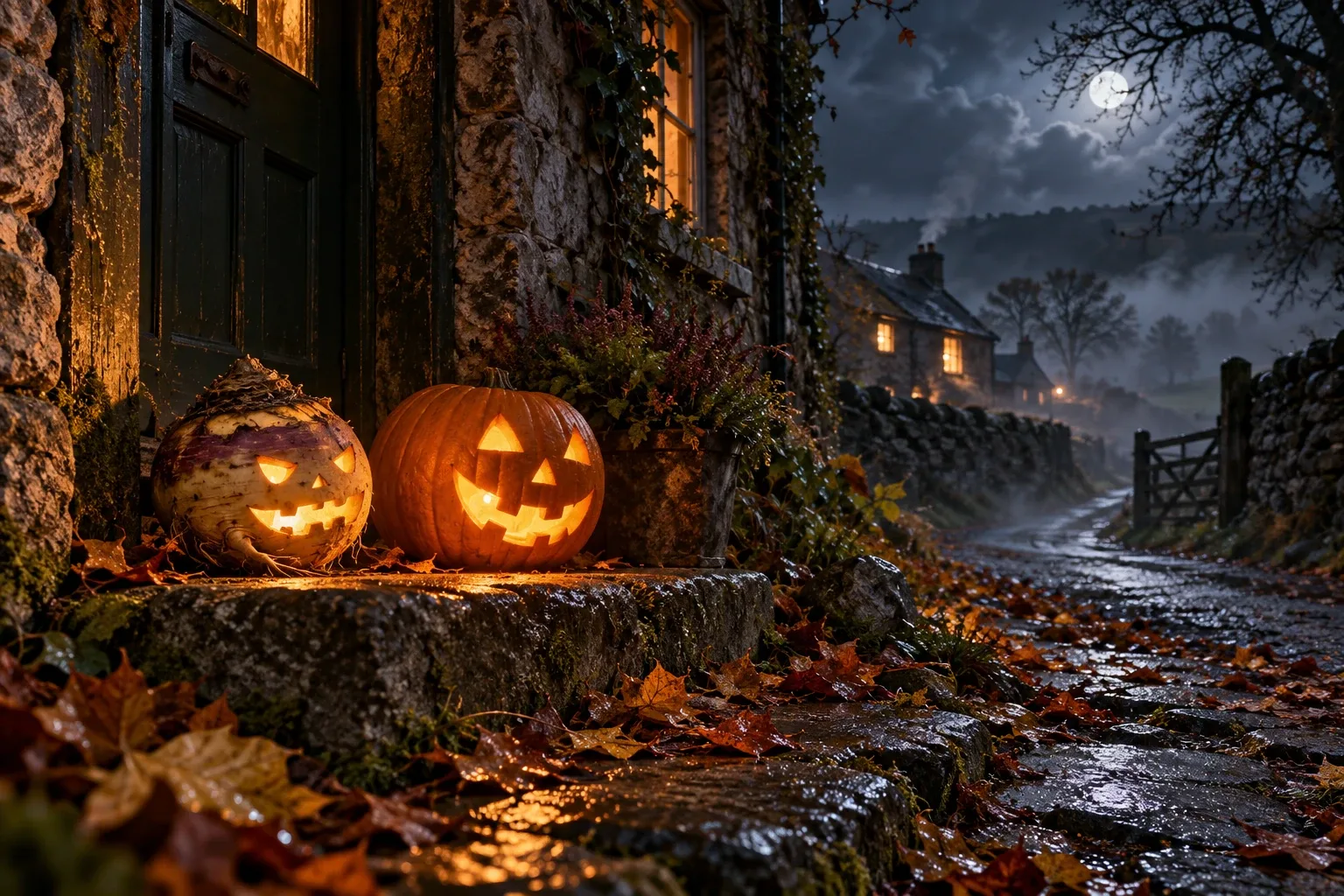
Britannica says that on Samhain, people feared roaming spirits — beloved dead and worse — and wore masks or disguises to blend with supernatural visitors. That guising impulse, the piece argues, still echoes in ghost and witch costumes even when the original purpose is forgotten.
History.com’s Halloween and Samhain explainers add bonfires, homage to the dead, and later mumming: costumes, door visits, songs for the dead, cakes as payment.
If the night lets otherworldly traffic through, looking like traffic is a strategy. (The fairy-kidnap angle has its own story: sidhe, disguise and camouflage.)
Souling — cakes for prayers
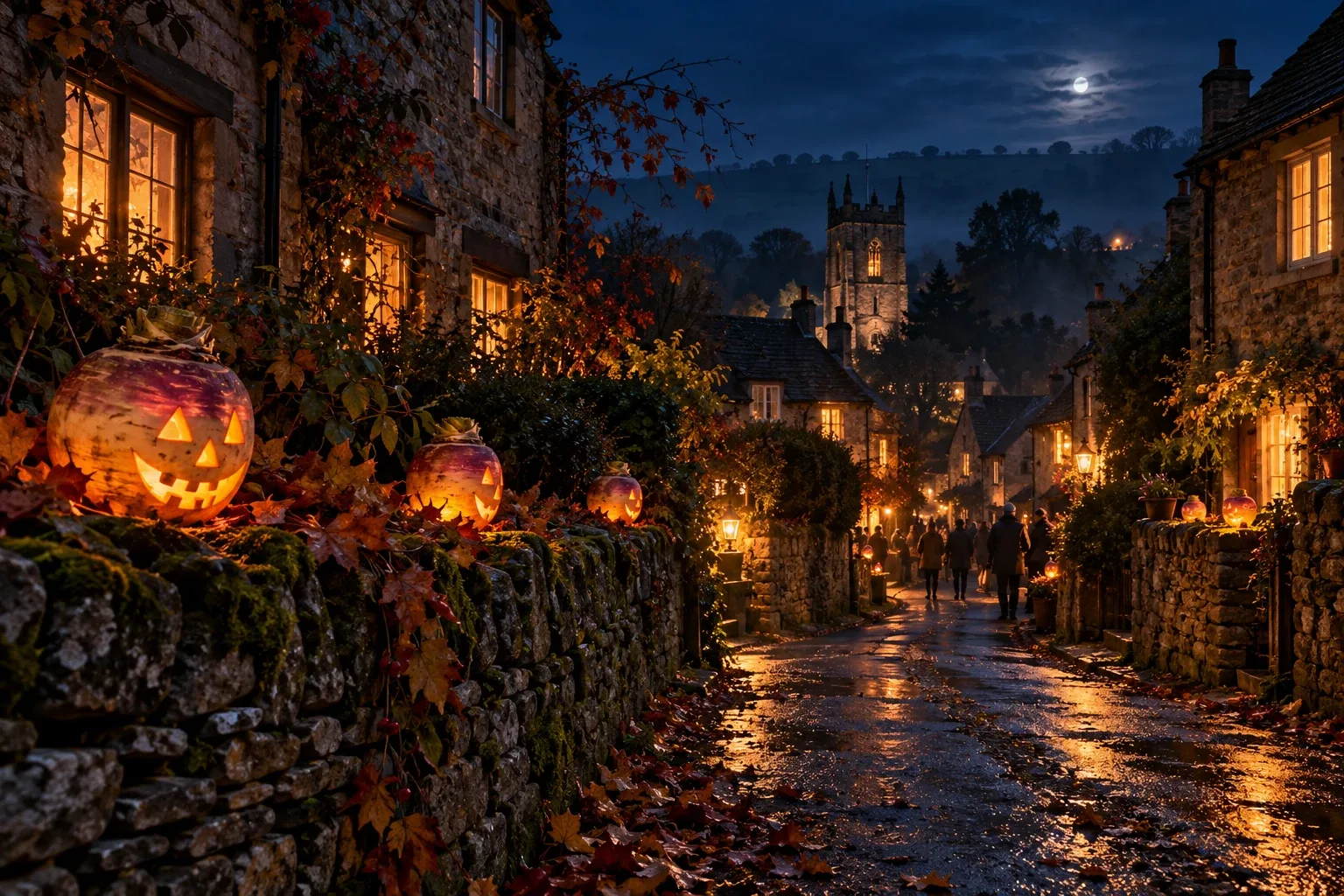
By the Middle Ages, Britannica continues, guising evolves into souling: the poor visit wealthier homes for soul cakes and promise prayers for the household’s departed. History.com dates a major All Souls’ Day framing to around 1000 A.D. and describes the same cake-for-prayer bargain; children later take up the rounds asking for food, money, or ale.
BBC Culture notes soul cakes / “soulmass” cakes on doorsteps as spirit-ward and charity, and records souling as a Christian town custom in England at Halloween and Christmas. Wikipedia’s trick-or-treating page (useful as a pointer, not gospel) places soul-cake sharing across Allhallowtide from the fifteenth century onward and even flags Shakespeare’s Hallowmas beggar jab.
Farmers’ Almanac stresses the class structure: poor at rich doors, cinnamon-spiced cakes, prayers as currency — later a children’s circuit.
That’s the moral engine under today’s candy: intercession monetized in pastry, then demoralized into sugar.
Guising — perform first, collect second
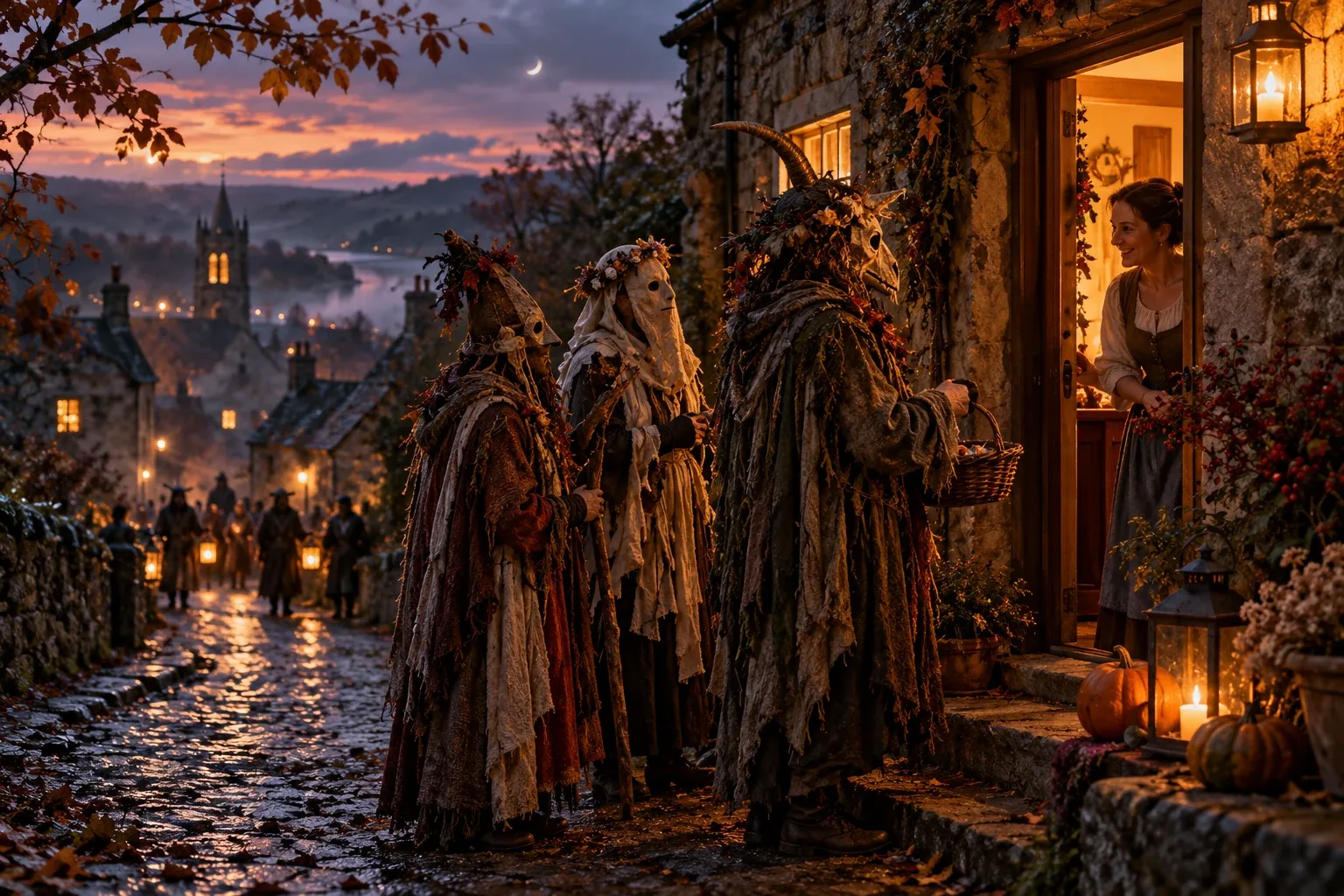
In Scotland and Ireland, History.com says, guising meant costumes plus a performance — song, poem, joke, or other “trick” — before collecting fruit, nuts, or coins. Not necessarily prayers. Hospitality earned by show.
That performance clause matters. American trick-or-treat often dropped the talent show and kept the threat. The older North Atlantic versions made you work for the apple.
America: pranks, pressure valves, and a phrase
History.com reports Irish and Scottish communities reviving souling/guising in the U.S. by the early twentieth century — then notes that by the 1920s, pranks were the preferred Halloween activity for rowdy youth. Farmers’ Almanac places destructive pranking around the Depression era as the moment activities harden into “trick-or-treating.” Britannica and Almanac tradition pages describe treat culture as a civic answer to vandalism energy.
Mischief Night (and darker urban cousins like Devil’s Night in popular memory) sits beside this reform story: a licensed disorder evening that communities keep trying to bribe back into costume theater.
Post–World War II candy abundance, multiple explainers note, finishes the transformation into the sealed-wrapper porch raid kids now treat as natural law.
Mumming’s middle chapter
History.com’s Samhain article describes Irish mumming on nights leading to Samhain: costumes, door-to-door songs honoring the dead, cakes as payment. That sits between “hide from spirits” and “collect branded chocolate.”
Mumming traditions elsewhere in Britain also staged folk plays — heroes, fights, absurd horses — sometimes near All Souls. BBC News’ coverage of Cheshire souling troupes shows the custom still performed as community theater with cakes at the end. The candy aisle didn’t invent participatory October. It simplified the script.
What “trick” used to mean
In guising, the “trick” could be the performance itself — a rhyme or joke delivered before the treat. In American street slang, “trick” tilted toward vandalism: soap on windows, smashed pumpkins, worse.
That semantic slide is the reform story’s engine. If the threat becomes real property damage, neighborhoods invent a cheaper ransom. Enter porches with bowls. Enter parents as security escorts. Enter the phrase that makes the ransom sound like a game.
Mischief Night’s awkward cousin status
Mischief Night — typically the night before Halloween in parts of the Mid-Atlantic and elsewhere — is not identical to trick-or-treat, but it shares DNA: licensed misbehavior on the seasonal hinge. Some towns treat it as prank eve; Halloween becomes the costumed apology tour.
Devil’s Night lore in Detroit’s popular memory is the dark mirror — arson anxiety, curfews, community patrols. Mention it carefully: it’s urban history and media narrative, not proof that “Halloween causes fire.” It is proof that autumn disorder nights keep renegotiating their social contract.
Why the origin story still ranks
Every October, people ask “why do we trick-or-treat?” because the behavior is weird if you didn’t grow up inside it: strangers, masks, demand, sugar.
The answer that satisfies without lying: because Christian charity rounds, Celtic-season disguise customs, and American anti-vandalism campaigns collided — and candy companies showed up with logistics.
Samhain taught the night. Souling taught the knock. Guising taught the mask. Mischief taught the leverage. America taught the SKU.
What changed — and what didn’t
- Older logic: Pray for our dead
Modern residue: Rarely; sometimes church trunk-or-treat framing - Older logic: Perform a rhyme
Modern residue: Occasionally; often skipped - Older logic: Appease spirits / fairies
Modern residue: Plastic décor cosplay - Older logic: Threat of fairy/human mischief
Modern residue: “Trick” as joke threat - Older logic: Cakes, fruit, nuts, ale
Modern residue: Branded candy
A cynical take: we kept the knock and outsourced the metaphysics to Mars, Inc.
Grain of salt: kids like sugar; cities like unbroken windows. Both motives scale.
Bottom line
Trick-or-treat is souling’s charity mask, guising’s costume hustle, and American mischief management — welded onto a Samhain-season night that already taught people to bargain with whatever walks.
The candy is new. The door negotiation isn’t. October just keeps renegotiating the terms.
Attribution / sources
- Claim element: Souling, guising, U.S. prank-to-treat arc
Attribution: HISTORY.com trick-or-treat origins
Link: history.com/articles/halloween-trick-or-treating-origins - Claim element: Guising/Samhain disguises; souling evolution
Attribution: Britannica, History of Trick-or-Treating
Link: britannica.com/topic/History-of-Trick-or-Treating - Claim element: Soul cakes; children’s rounds; Depression-era naming
Attribution: Farmers’ Almanac
Link: farmersalmanac.com/why-do-we-trick-or-treat - Claim element: Soulmass cakes; Christian souling custom
Attribution: BBC Culture Samhain to Soulmass
Link: bbc.com/culture/article/20241030-samhain-to-soulmass-the-pagan-origins-of-familiar-halloween-rituals - Claim element: Tradition overview
Attribution: Old Farmer’s Almanac
Link: almanac.com/origins-halloween-traditions
Protective footer
This article is entertainment and folklore commentary for a mature audience. It summarizes publicly available historical claims about trick-or-treating, souling, and guising. It is not historical or legal advice. Folk reconstructions vary by region and source—take them with a grain of salt. Monstrum Athenaeum does not encourage vandalism or unsafe door-to-door activity. Links are for attribution and verification.
Dramatic recreation — Monstrum Athenaeum