Folklore and cultural history Western Christian traditions; Rome and Cluny
Allhallowtide Explained: Halloween, All Saints and All Souls
What October 31, November 1 and November 2 mean in the Christian calendar, and how their histories connect with Halloween.
Sign in to save stories to your shelf.
Halloween gets the bright window display. November 1 and 2 are easier to overlook. Together, though, the dates tell a larger story about remembrance: the evening before a feast, the celebration of saints and prayer for the faithful departed.
Allhallowtide commonly refers to All Hallows' Eve on October 31, All Saints' Day on November 1 and All Souls' Day on November 2. It is a useful name for this cluster of Western Christian observances, not a claim that every Christian church follows the same calendar or theology.
October 31: what does All Hallows' Eve mean?
“All Hallows” refers to all saints; the eve is the preceding evening. Halloween's name carries that Christian calendar reference even when the celebration itself consists of costumes, sweets and parties.
The linguistic connection is more straightforward than the history of every custom associated with the night. The BBC's All Hallows' Eve overview discusses arguments about the relationship between Halloween and Samhain, including challenges to simple accounts of one festival being replaced by another.
A useful distinction follows: the name's Christian history does not prove every Halloween custom began in church. Equally, a custom involving fire or spirits is not automatically evidence of an unchanged pre-Christian rite.
People can inherit a word, an activity and a story through different routes. They do not have to arrive together.
November 1: All Saints' Day
All Saints' Day honours all the saints, including those without an individual feast in the calendar. It is not merely a celebration of the famous or formally recognized few.
Church-history sources trace the observance through earlier commemorations of martyrs and the dedication of the Pantheon in Rome under Pope Boniface IV in the early seventh century. That Roman dedication was associated with May 13. Later developments helped establish November 1 in the Western calendar.
The Catholic Encyclopedia's historical overview is one source for the familiar account involving Gregory III, Gregory IV and the spread of the November observance. It should be read as a church-history account rather than treated as a secret explanation of why every Halloween custom exists.
In particular, “a pope cancelled Samhain and moved everyone to November” is not an adequate summary. The calendar developed over time and across regions. An outcome shared by two traditions is not proof of a single intention behind it.
November 2: All Souls' Day
All Souls' Day, formally the Commemoration of All the Faithful Departed in the Roman Catholic calendar, concerns prayer for the departed. Its theological meaning should not be reduced to ghost stories or an attempt to summon ancestors.
Vatican News's account of the observance identifies Abbot Odilo of Cluny's establishment of a November 2 commemoration in the monasteries under his authority in 998 as an important development. The practice subsequently spread; it was not the invention of prayer for the dead itself.
The distinction between All Saints and All Souls is therefore theological, not a division between famous people and everyone else. In Catholic teaching, the former celebrates the saints in heavenly glory; the latter includes prayer for the faithful departed undergoing purification.
Readers outside that tradition need not share the belief to understand what the observance means to those who practise it. Accurate description is more useful than turning the calendar into a supernatural attraction.
Why the dates belong together
Placed side by side, the observances move from the eve of a feast to the celebration of saints and the commemoration of the departed. They connect communal belief with personal remembrance.
This helps explain why a Halloween history that stops at the evening of October 31 feels incomplete. The next two days have their own purposes; they are not simply an after-party for costumes.
It also helps explain why customs vary. A church service, a cemetery visit, family remembrance and a secular party may fall within the same few days without being equivalent activities. A label such as Allhallowtide is a guide to the calendar, not a guarantee that everyone celebrates it identically.
Soul cakes and the appeal of a neat origin story
Accounts of souling describe receiving cakes or other food in connection with prayers for the dead. The exchange makes a memorable comparison with later door-to-door Halloween treats.
Sources including BBC Culture's discussion of Halloween rituals, explore these connections. But the comparison should not become a claim that every modern trick-or-treater is unknowingly performing an unchanged medieval practice.
The Library of Congress's examination of masking and mumming cautions against an assumed direct transmission into American trick-or-treating. Similarity is a starting point for historical inquiry, not its conclusion.
The older custom remains interesting without that extra claim. Food, hospitality, obligation and remembrance meet at the doorstep. The household gives something tangible; the visitor promises something understood to benefit the departed. That is a different social and religious exchange from a modern candy bowl.
Is Allhallowtide another name for Samhain?
No. Samhain belongs to Gaelic seasonal history and to living contemporary observances. Allhallowtide describes Christian dates and their associated practices. Halloween has developed in contact with multiple traditions.
There are overlaps in season, imagery and popular custom, but the words should not be used as interchangeable labels. A claim about a medieval Irish literary story does not automatically describe a Catholic feast. A modern Pagan ancestor observance does not establish what every ancient community did.
Popular retellings sometimes frame Christianity as merely relabelling an older festival. That may be an appealing story, but it gives a complicated history a certainty it does not deserve. The more useful question is which practice is documented, in which place, at which time.
Not every Christian calendar works the same way
All Saints is observed in different ways across Christian traditions, and the November dates are not universal throughout Christianity. Beliefs about the departed and the role of prayer also differ.
For that reason, statements about obligations, liturgy or purgatory need to identify the tradition being described. A broad cultural-history article should not present one church's teaching as a universal Christian rule.
The distinction also matters in American Halloween debates. A parish celebration, a community party and a family that declines Halloween may all reflect different choices within religious life. Their existence is not evidence of a hidden agreement about the night's supernatural meaning.
Remembrance beyond this calendar
Mexico's Día de Muertos should not be treated as simply “Mexican Halloween” or a copy of Allhallowtide. Its own Indigenous and Catholic histories deserve a separate account.
The Library of Congress's Halloween and Día de Muertos research guide treats the holidays as related but different. That is a better starting point than assuming that any candle, grave decoration or autumn remembrance belongs to the same tradition.
A similar image can serve different purposes. Respecting the distinction leaves more to discover, not less.
Reading the three days clearly
For an October reader, the practical map is simple:
- October 31 — All Hallows' Eve: the evening before All Saints; the source of Halloween's English name.
- November 1 — All Saints' Day: a celebration of all saints in the Western traditions that observe this date.
- November 2 — All Souls' Day: remembrance and prayer for the faithful departed, particularly in the Roman Catholic calendar.
The historical route to those observances is more complex than the calendar summary. Keep that complexity where it belongs, rather than replacing it with a slogan about one religion stealing another's holiday.
Allhallowtide gives Halloween a wider setting. Beyond the costume at the door are days devoted to holiness, mortality and the people a community remembers. The candle can be beautiful without needing a ghost behind it.
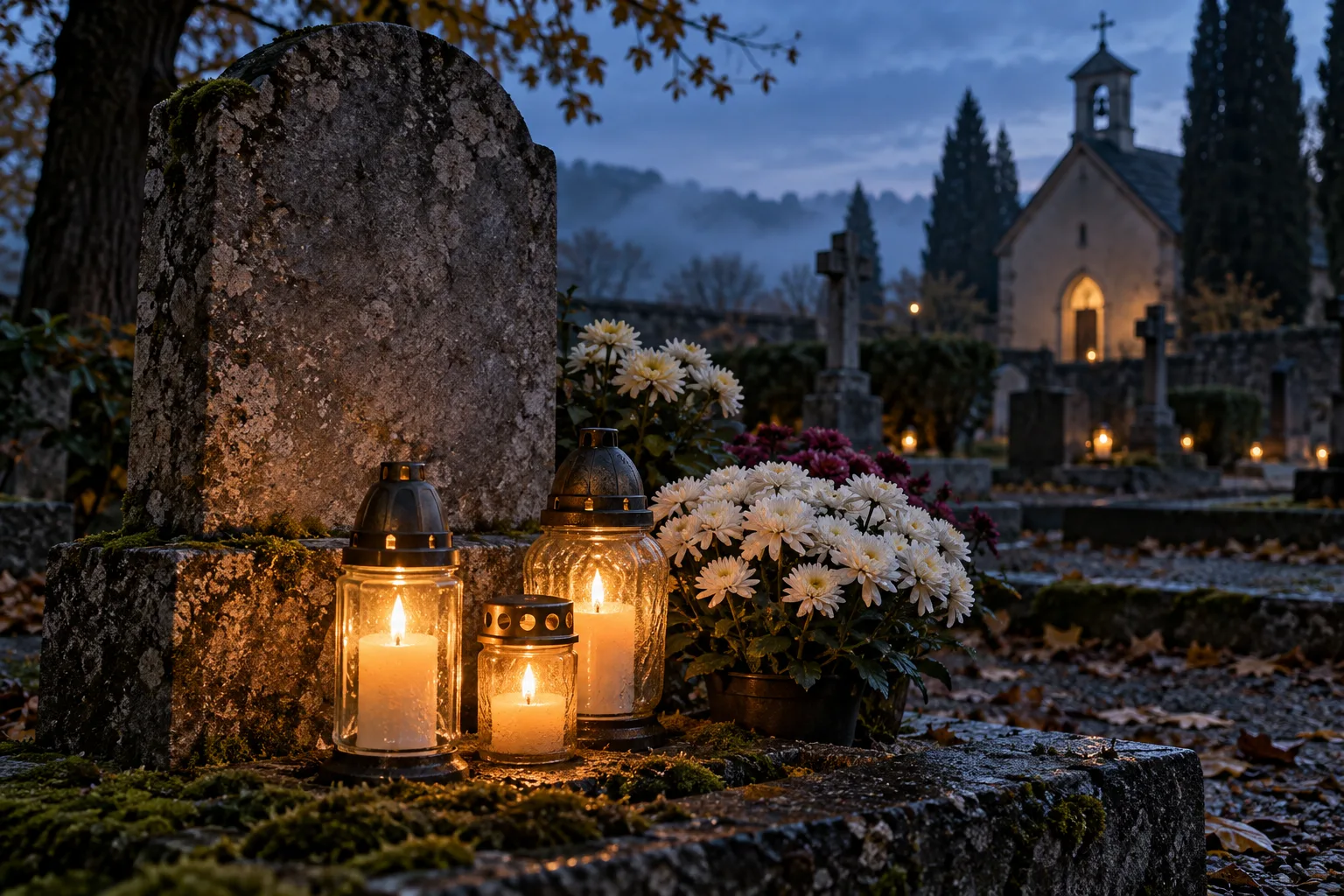
Cover artwork is a conceptual remembrance scene, not a photograph of a named cemetery or documented ceremony.