Folklore and cultural history Ireland and the Gaelic cultural world
Samhain Explained: Folklore, the Otherworld and Halloween
Explore Samhain’s winter threshold, Otherworld stories and Halloween connections—and where recorded history differs from modern interpretation.
Sign in to save stories to your shelf.
Forget the foam tombstones for a moment. Samhain marks the beginning of winter in the Gaelic seasonal calendar, with celebrations associated with the preceding evening, October 31. Its stories gather around a familiar threshold: the harvest behind you, the dark months ahead, and the possibility that the household is not quite as alone as it looks.
That makes Samhain an important part of Halloween's history. It does not make every Halloween custom an unchanged survival from ancient Ireland. The interesting story lies in the layers: seasonal observance, medieval storytelling, later recorded customs and living religious practice.
What does Samhain mean in the calendar?
The National Museum of Ireland's account of Halloween customs places Samhain on November 1, the first day of winter, with much of the celebrating on the evening before. It describes feasting, games, marriage divination, disguises and beliefs about returning spirits.
That is a useful starting point because it tells us what kind of evidence we are looking at: recorded tradition. It is not an eyewitness report from pre-Christian Ireland. A custom collected in recent centuries can be old without supplying its own date of invention.
Popular histories often call Samhain the Celtic new year. The phrase captures the importance of a seasonal turning, but can become misleading if it suggests one uniform calendar followed identically across every place described as Celtic. Ireland, Scotland, Wales and other regions have distinct histories. A shared autumn atmosphere does not erase them.
In everyday terms, the season mattered because winter mattered. Food, livestock, shelter and the lengthening night were practical concerns before they became an aesthetic. Samhain's power as a storytelling setting comes partly from that meeting of household life and uncertainty.
What is the “thinning veil”?
“The veil between worlds grows thin” is a familiar way of describing Samhain today. Treat it as language expressing a belief, not a measurable event or a quotation that can automatically be assigned to ancient celebrants.
HISTORY's Samhain overview describes traditions in which the boundaries between the human world and an Otherworld become unusually permeable. Visitors, fairies and the dead enter its account. The museum's description likewise records beliefs that the dead might return home and that dangerous spirits were active.
These ideas should not all be flattened into one supernatural population. Ancestors, Christian souls, fairy beings and the figures of Irish literature are not interchangeable simply because a modern October illustration puts them in the same mist.
The distinction makes the stories better. A family preparing for the return of its dead is doing something different from a character encountering a dangerous Otherworld being. Both involve a boundary; what lies across it changes the story.
Why Irish stories return to Samhain
Popular histories associate Samhain with episodes from Irish literature, including The Adventures of Nera and the story of Fionn confronting Aillen at Tara. These are narrative traditions, not incident reports. A story set at a feast tells us about the significance a storyteller gives that occasion; it does not establish that its monster appeared there.
Nor should the date of a surviving manuscript be confused with the date when every element of its story first circulated. Oral transmission, literary composition and copying are different stages. “Ancient” is often used to blur them together.
For the reader, the recurring setting still matters. A gathering, a feast and a dangerous crossing make Samhain a natural place for a tale to turn. The ordinary rules of hospitality and protection become unusually consequential. The house has a door. Tonight the story asks who might knock.
Fire, food and disguises
Bonfires appear prominently in accounts of Samhain and Halloween. BBC Culture's discussion of familiar Halloween rituals explores the relationships between seasonal celebrations and later practices. Such comparisons are useful, but a resemblance is not by itself proof of continuous transmission.
The same caution applies to costumes. Popular explanations describe disguises as protection from supernatural beings; recorded customs also include visiting, entertaining and frightening neighbours. There need not be one original purpose behind every mask.
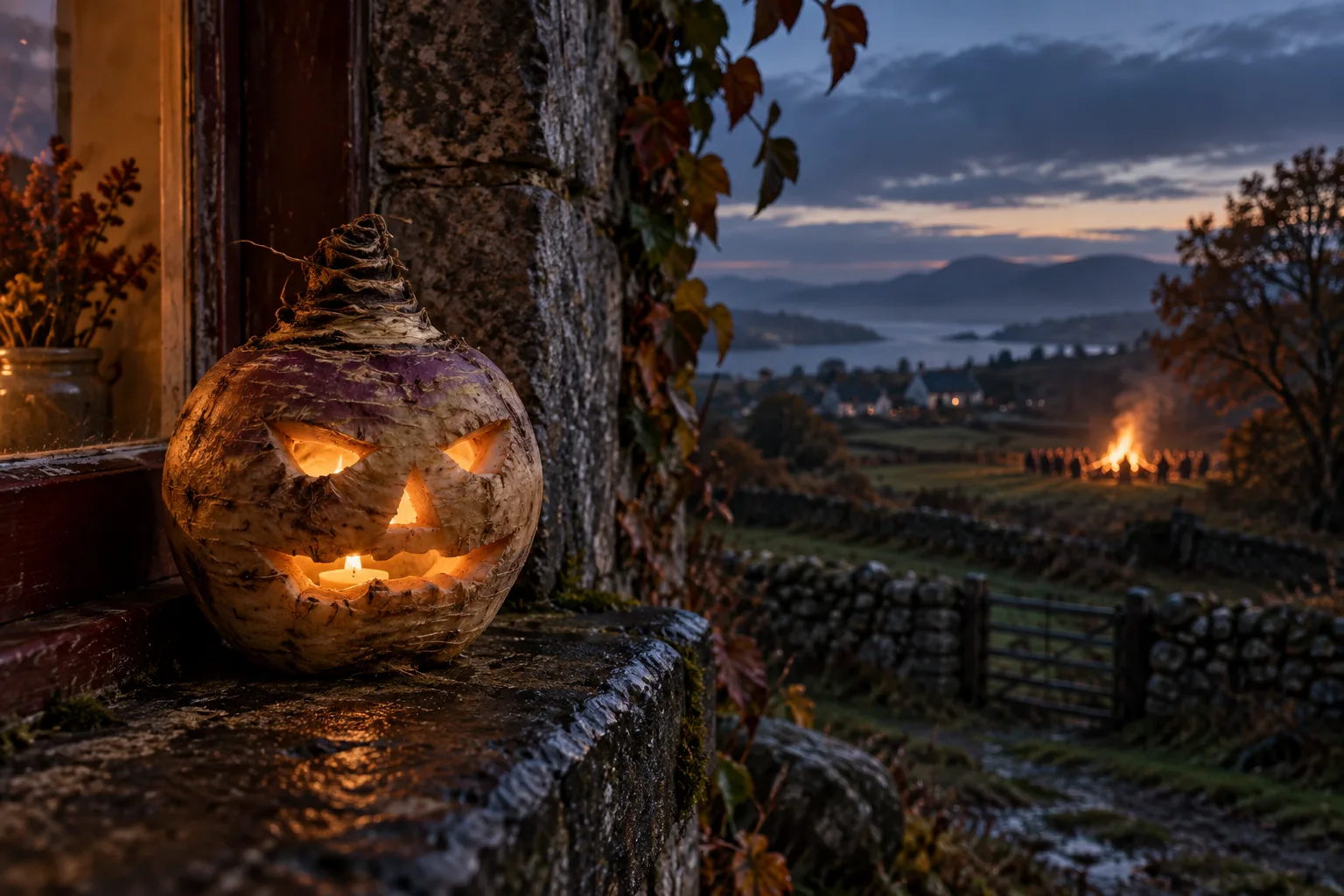
The National Museum's ghost-turnip collection record offers a more tangible trail: a lantern received from a Donegal schoolteacher in 1943. An object with a collection history is a firmer point of reference than an unsupported claim that every lantern practice is thousands of years old.
It also explains why the turnip deserves a place beside the pumpkin. Halloween's visual history is stranger and more regional than its modern shop display suggests.
Samhain and the Christian calendar
Halloween's English name comes from All Hallows' Eve: the evening before All Saints' Day. All Souls' Day follows on November 2 in the Roman Catholic calendar. These Christian observances have their own histories and meanings.
Popular accounts sometimes compress this into a pope moving a pagan festival and creating both November observances at once. That is too tidy. The history of All Saints and the development of All Souls should be distinguished, as should a documented calendar decision from an inferred intention to replace a local custom.
The BBC's All Hallows' Eve overview discusses disagreement over simple pagan-to-Christian origin stories. The honest account allows contact, adaptation and regional variation without inventing a single moment when one festival became another.
Tara is not Tlachtga
County Meath appears frequently in modern Halloween-origin reporting. Tara and Tlachtga, also called the Hill of Ward, are separate places. A story associated with one should not be illustrated, mapped or described as though it happened at the other.
BBC Travel's Meath feature explores the region's traditions and modern festival tourism. “Birthplace of Halloween” is an appealing visitor invitation; the full history still involves multiple places, periods and communities.
A cultural landmark is also not a sighting location. Nothing in these stories establishes an actual creature encounter or gives permission to enter restricted land.
Modern Samhain is a living observance
Many contemporary Pagans observe Samhain as a seasonal festival, sometimes emphasizing ancestors, remembrance or the turning of the year. Practices differ between communities and individuals. They should be described on their own terms rather than treated as costumes for an imagined universal ancient rite.
Some popular histories emphasize an expansion in the 1980s. That is not an adequate starting date for Wicca: the Museum of Witchcraft and Magic records Gerald Gardner's public association with its predecessor museum in 1951. Modern religious history and claims about ancient continuity are separate questions.
You do not have to share a religious belief to describe it accurately. Equally, acknowledging a modern development does not make the practice meaningless to its participants.
Reading the threshold
The most useful question is not whether every October custom can be traced to a single ancient bonfire. It is which evidence supports which part of the story.
Museum objects show particular customs. Historical texts show what their writers recorded. Literary narratives show imagined encounters. Contemporary communities explain what they practise now. Read those records together without pretending they are the same kind of document.
Samhain remains a compelling entrance into Halloween because it places the familiar close to the uncertain: a meal, a mask, a light at the window, the dark beyond it. There is enough mystery in that history without manufacturing certainty.
Cover artwork is a conceptual illustration of Samhain folklore, not a photograph of an ancient ceremony or a museum object.