Folklore and cultural history United States; Irish and Scottish cultural connections
How Halloween Became an American Tradition
How immigration, Samhain, Allhallowtide, pumpkins and twentieth-century celebrations helped shape American Halloween.
Sign in to save stories to your shelf.
America did not invent every part of Halloween. It gave a collection of older customs a remarkably durable new form: the pumpkin on the porch, the costume at the door and the expectation that the household should have something sweet ready.
Modern American Halloween grew through a mixture of immigration, local celebrations, religious calendars, entertainment and commerce. Samhain belongs in that history, but “an ancient festival crossed the Atlantic and became trick-or-treating” skips most of the interesting work.
The older traditions did not travel as one package
HISTORY's overview of Halloween and Britannica's account connect the holiday with Gaelic Samhain and the Christian observance of All Hallows' Eve. Irish and Scottish immigrants brought customs that contributed to celebrations in North America, especially as migration increased during the nineteenth century.
They did not arrive carrying an unchanged prehistoric festival. Their traditions had already developed within Christian societies and alongside regional practices. Disguises, games, lanterns and seasonal mischief could mean different things in different communities.
The immigrant contribution is important precisely because these were living customs. People adapted celebrations to new neighbours, available materials and local expectations. Tradition travelled through families and communities, not as a sealed box marked “authentic Halloween.”
The Christian name stayed on the door
“Halloween” comes from All Hallows' Eve, the evening before All Saints' Day. All Souls' Day follows on November 2 in the Roman Catholic calendar. The three dates are often discussed together as Allhallowtide.
That naming history matters even to a reader whose own Halloween is entirely secular. The English word carries a Christian calendar reference. It is not simply another spelling of Samhain.
How particular folk customs interacted with those observances is a more complicated question. The BBC's discussion of All Hallows' Eve notes disagreement over simple origin accounts. Similar dates and recurring images of the dead do not establish that every practice followed one direct route.
The American story therefore begins with several histories already entangled. Churches, households and civic celebrations could retain different parts of them.
Souling and guising: relatives, not a proven family tree
Popular accounts often place two practices behind trick-or-treating. Souling involved receiving food in connection with prayers for the departed. Guising involved visiting in disguise, often with a performance in exchange for food or money.
Those resemblances are worth noticing. They do not prove an unbroken chain from a medieval soul cake to a twentieth-century American candy bag.
The Library of Congress's Folklife Today discussion of masking and mumming highlights that evidence gap. It discusses scholarship placing American trick-or-treating in the twentieth century and notes the lack of an identified source in which the people starting a community's practice said they were following souling or Guy Fawkes begging.
This is a useful correction to the neat family tree. Several door-to-door traditions can resemble each other; establishing direct descent takes evidence about who transmitted a practice, when and how.
The pumpkin's American role
A carved turnip can look considerably less friendly than the pumpkins sold in a supermarket display. Irish lantern traditions used root vegetables, while pumpkins became the familiar American Halloween material.
Accounts such as HISTORY's jack-o'-lantern account and National Geographic's discussion of lantern history discuss this transatlantic connection. It is best understood as adaptation rather than a single documented moment when one vegetable replaced another everywhere.
The pumpkin offered a large surface for a face and became a powerful visual symbol. Once printed illustrations, decorations and entertainment repeated it, a local object could function as a broadly recognizable holiday sign.
There is a difference between that cultural history and saying a particular carving design is an ancient survival. A glowing face can be traditional without every cut having a prehistoric meaning.
Mischief, parties and the changing bargain
American Halloween was not always organized around small children politely collecting sweets. Historical accounts describe pranks, disorder and attempts to channel the evening into supervised gatherings and community activities.
The Library of Congress's newspaper-based overview discusses mischief, changing customs and the growing place of treats. Newspapers and other dated records are valuable here because they show celebrations as contemporaries described them, rather than projecting today's familiar routine backwards.
HISTORY's account of trick-or-treating likewise places its American expansion within a twentieth-century story of community activity, popular culture and postwar growth. That is a different scale of claim from saying that ancient celebrants invented modern candy night.
The result was not simply a transaction imposed by a confectionery company. Families, children, neighbourhoods, schools and local organizers also shaped what the evening became. Commerce amplified a practice whose social life mattered.
Pictures taught strangers to recognize the same night
The holiday’s visual history includes newspapers, postcards, costume imagery and later screen entertainment as ways Halloween acquired a shared appearance. A witch, a cat, a ghost and a pumpkin could announce the occasion before anyone read the words.
That visual familiarity helped the holiday travel beyond the communities that had carried particular customs. People did not need the same family history to recognize a Halloween invitation or take part in a costume party.
It also created room for reinvention. The costume could become a joke, a favourite character, a homemade experiment or a frightening performance. The party could be a children's gathering or an adult celebration. A shared date does not require a single shared meaning.
There was never only one American Halloween
A national overview can hide local differences. Neighbourhood door-knocking, organized events, religious observances and adult nightlife are not identical celebrations. Neither are historical mischief traditions interchangeable simply because later summaries group them under Halloween.
The same household may recognize several versions. Someone can remember the dead in a religious setting, help a child with a costume and enjoy a horror film without treating those activities as one ritual.
Contemporary Pagan observances of Samhain add another living strand. They should not be described as beginning only in the 1980s, nor treated as a universal reconstruction of ancient Ireland. Their modern histories deserve the same care as immigrant and Christian histories.
A timeline without a false shortcut
- Earlier Gaelic and Christian traditions: seasonal observance, stories and religious calendars contribute different elements to the wider history.
- Nineteenth-century North America: immigrant communities and local celebrations help shape a developing holiday culture.
- Early twentieth century: parties, mischief and emerging trick-or-treat practices take varied forms.
- Mid-twentieth century and after: mass-produced goods, entertainment and neighbourhood participation help establish the familiar American celebration.
These are broad stages, not a claim that every town changed on the same date. Nor is a shared practice proof that every participant understood it as a survival from Samhain.
What the origin story leaves us with
The compelling part of American Halloween is not that it kept an ancient festival untouched. It is that people kept finding uses for a night of disguise, visiting, play and uneasy fascination with death.
The pumpkin became a sign that the house was participating. The costume offered a brief change of identity. The doorstep became a place where strangers could follow a familiar script. Those are social achievements as well as commercial opportunities.
Samhain is one important history behind that scene. So are Allhallowtide, immigrant customs and the twentieth-century communities that made Halloween recognizably American. Keep the multiple histories in view, and the night becomes more interesting rather than less.
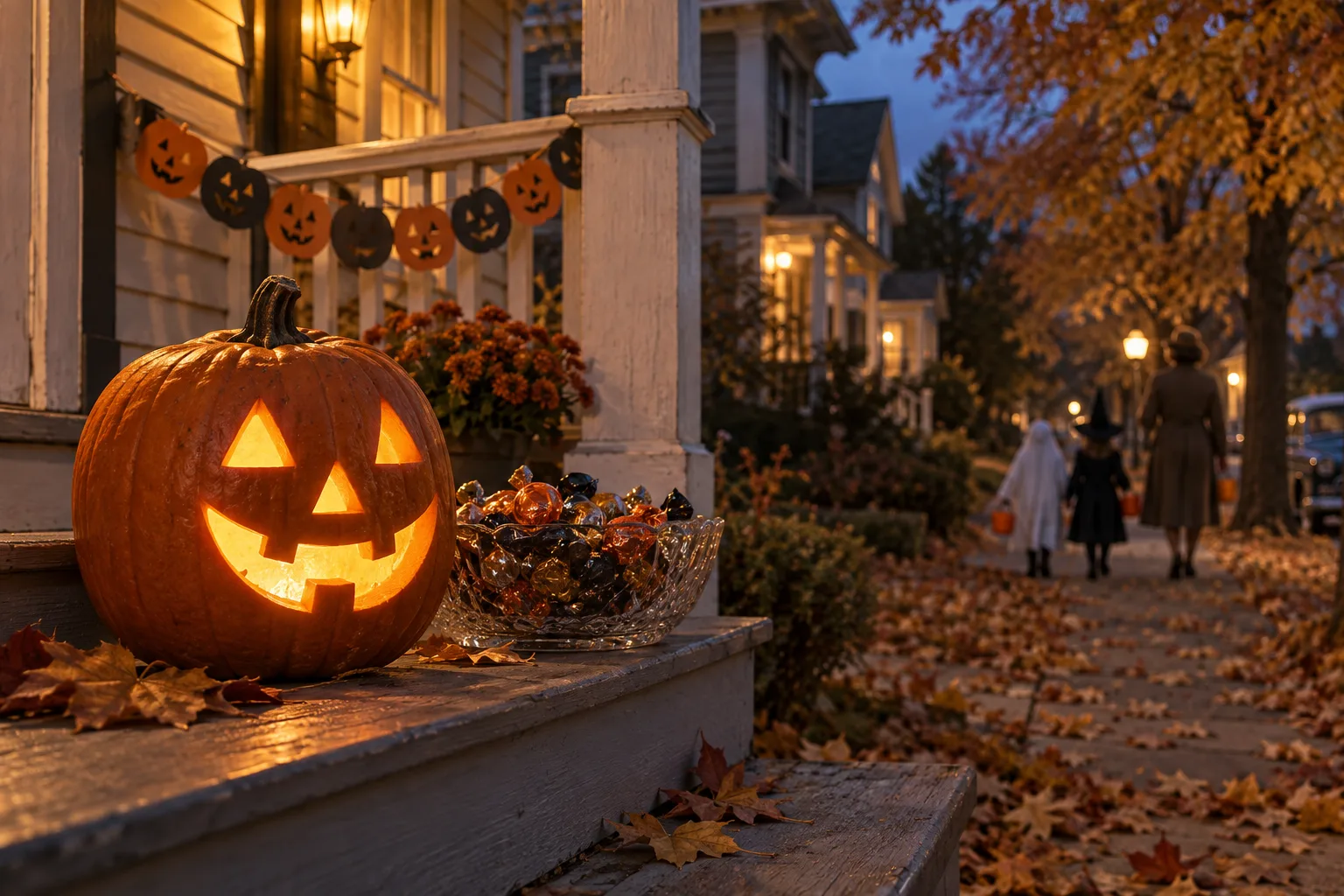
Cover artwork is a dramatic recreation of a mid-twentieth-century Halloween scene, not an archival photograph.
Continue in the library
Dramatic recreation — Monstrum Athenaeum