Folklore and cultural history England; historical souling traditions
How to Host a Soul Cake Night
Plan a cosy soul-cake evening with spiced cakes, stories and remembrance, inspired by household books and the history of All Souls’ Day.
Sign in to save stories to your shelf.
A plate of cakes can carry more atmosphere than a roomful of plastic skeletons. Put it near the door, lower the lights, and invite your guests to exchange a rhyme for something warm and spiced.
A soul-cake evening borrows from the documented customs surrounding All Souls’ Day. It gives you an October or early-November gathering built around food, memory and a little theatrical begging. The aim is a welcoming night inspired by old records, not a claim that your kitchen has reproduced one universal seventeenth-century ceremony.
What were soul cakes?
The Records of Early English Drama North-East project’s Soul Cake Bake page connects cakes with seasonal rounds of song, performance and requests for food, especially in northern and western England. All Souls’ Day falls on November 2. The cakes belonged to a Christian setting of charity and remembrance, although customs varied.
You will often see souling described as an ancestor of trick-or-treat. It is a useful comparison, but not proof of a simple, uninterrupted route from every old doorstep to the modern candy bowl. Enjoy the resemblance without making the family tree tidier than the evidence.
A household book supplies the scent
The Durham project reproduces a recipe from Elinor Fettiplace’s household book, compiled around 1604. Its ingredients include flour, sugar, butter, nutmeg, cloves and mace, along with sack and ale barm; fruit or saffron could be added. It is an evocative list rather than a complete modern baking method: the quantities are missing.
For tonight, use a tested contemporary recipe for spiced biscuits or small buns, or buy a batch you like. Describe them as inspired by the historical ingredients. Do not promise that a particular texture, cross on top or modern substitution is the authentic shape of every soul cake.
The shopping can be modest. You need enough cakes for everybody to have one and enough extra that nobody has to choose between participating and being hungry. Apples, tea and warm apple juice make easy companions. A cake stand is optional; a clean board has all the theatre you need.
Ask about dietary needs before shopping. Keep ingredient information available, separate alternatives where necessary, and follow the chosen recipe and storage instructions. An alcohol-free recipe is the simplest choice for a mixed group. Do not assume baking removes all alcohol.
The cakes had their critics
The same Durham account cites Philip Stubbes’s 1593 attack on the custom and an account of a souling rhyme associated with John Aubrey around 1697. The records preserve disagreement as well as participation. Pastry and remembrance could sit inside a serious religious argument.
That is a better conversation starter than pretending to have discovered a secret recipe. Tell guests that even these little cakes had detractors. Then let the table decide which family food would provoke the fiercest argument today.
Give the door a line to say
Shakespeare offers another small piece of the atmosphere. In The Two Gentlemen of Verona, Act II, scene 1, Speed teases Valentine for learning to “speak puling, like a beggar at Hallowmas.” It is a joke about a lover’s behaviour, not a recipe or a complete account of souling.
The line works as a brief introduction: this calendar season and its begging customs could furnish an audience with a recognisable comparison. You need not claim Shakespeare personally watched the particular cake round you are imagining.
For your own doorway, invent a short call-and-response and identify it as yours. The visitor asks, “A cake for a story?” The host answers, “Only if the story is good.” Anybody who would rather skip the performance gets a cake anyway.
If your group wants to read the old rhyme, the Durham page supplies it with attribution. Keep the original Christian language in its historical setting. Do not press guests into a prayer or make somebody’s beliefs the joke.
Set a table that makes people linger
Use a board or platter, mugs, a cloth and soft electric light. A little autumn foliage can suggest the season without taking over the table. Make room for people to sit comfortably and hear one another. The atmosphere should invite conversation rather than demand that everybody act frightened.
A lantern can be an atmospheric addition, but it does not turn your table into an exact reconstruction of Fettiplace’s household. If you include one, use an LED light. Keep the cake service and the decorative props separate.
Try an empty place card for somebody remembered, or a bowl of blank cards on which guests can write a name privately. These are optional modern hosting ideas. They are not instructions drawn from the 1604 recipe.
Host a Soul Cake night in seven steps
- Invite the right-sized group. Explain that this is food, stories and remembrance inspired by historical souling, with participation optional.
- Bake or buy. Use a reliable modern recipe or labelled shop-bought cakes. Prepare dietary alternatives with the same care.
- Set the board. Put cakes and warm drinks within easy reach. Use lamps or LED candles for atmosphere.
- Offer the door game. A rhyme, a story or a simple hello earns a cake. Nobody has to perform.
- Tell one piece of history. Choose the household recipe, the hostile pamphlet or Shakespeare’s line. Five minutes is plenty.
- Leave room for remembrance. Invite a memory, silence, toast or prayer according to the group’s wishes. Passing is always fine.
- Send something home. A wrapped cake and a link to the historical sources make a better keepsake than a claim about secret ancient rites.
Keep the doorstep friendly
Run the event among invited participants. An unfamiliar neighbour should not have to work out whether a costumed stranger wants charity, a performance or access to their home. If you add a charitable collection, make it clearly optional and explain where it will go.
Children can help choose the cakes, arrange the board or tell a story, with an adult handling the kitchen tasks appropriate to their age. Quiet guests can simply eat and listen. The whole point is hospitality.
Pastry, prayer and the pleasure of a good source
A household recipe, an irritated pamphleteer and a line in a play do not describe exactly the same evening. Together they offer points of entry into an older seasonal world. The pleasure is in knowing which part comes from the record and which part you have made for your own guests.
For the calendar behind the custom, read Allhallowtide explained. For games with a more mischievous courtship mood, try our old-ways Halloween evening inspired by Burns.
Put the kettle on. Leave enough cake for late arrivals. The dead have occupied plenty of Halloween stories; tonight, make the living feel welcome too.
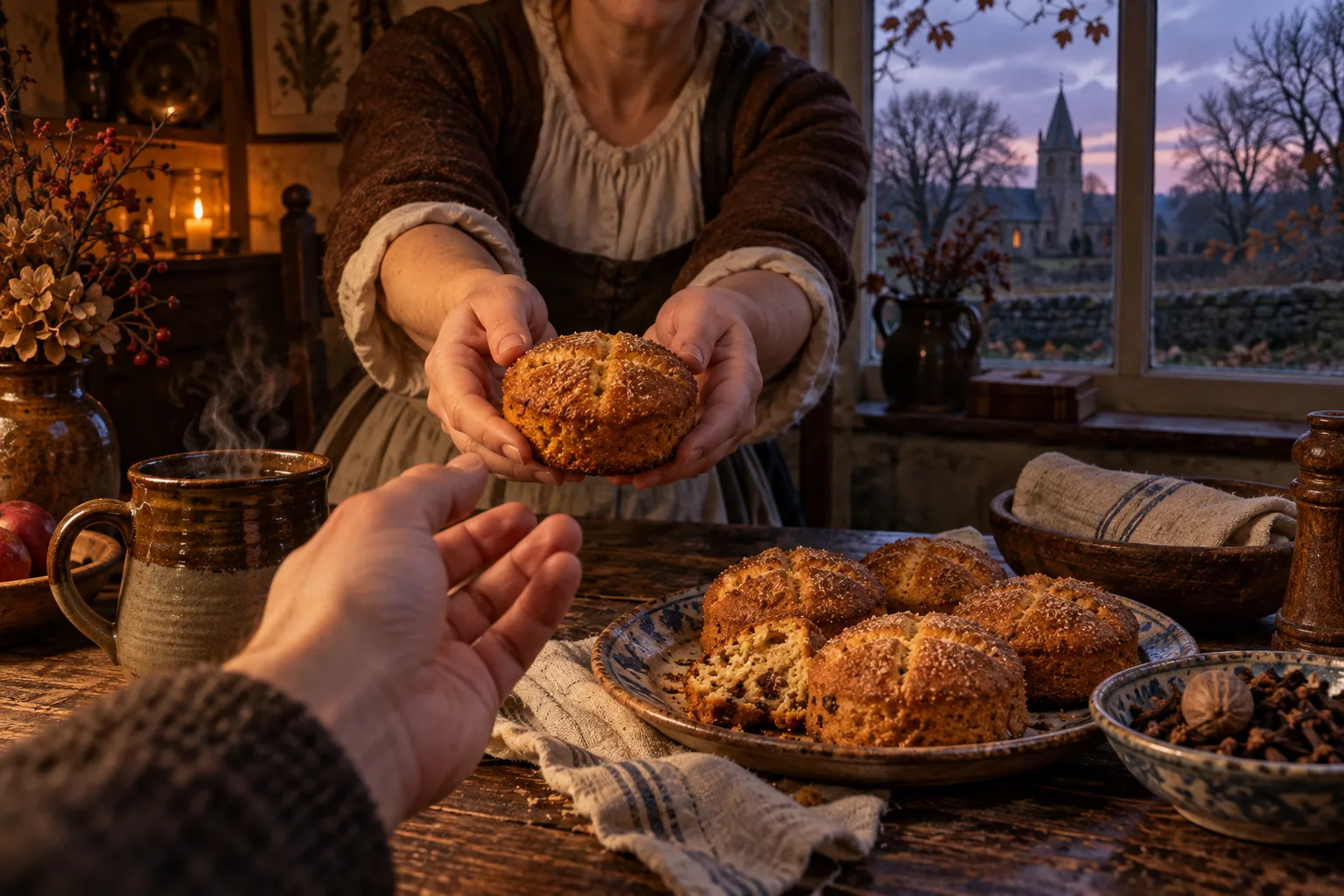
Cover: a conceptual recreation of a soul-cake gathering. The pictured cakes are illustrative, not a reconstruction of the unmeasured historical recipe.